


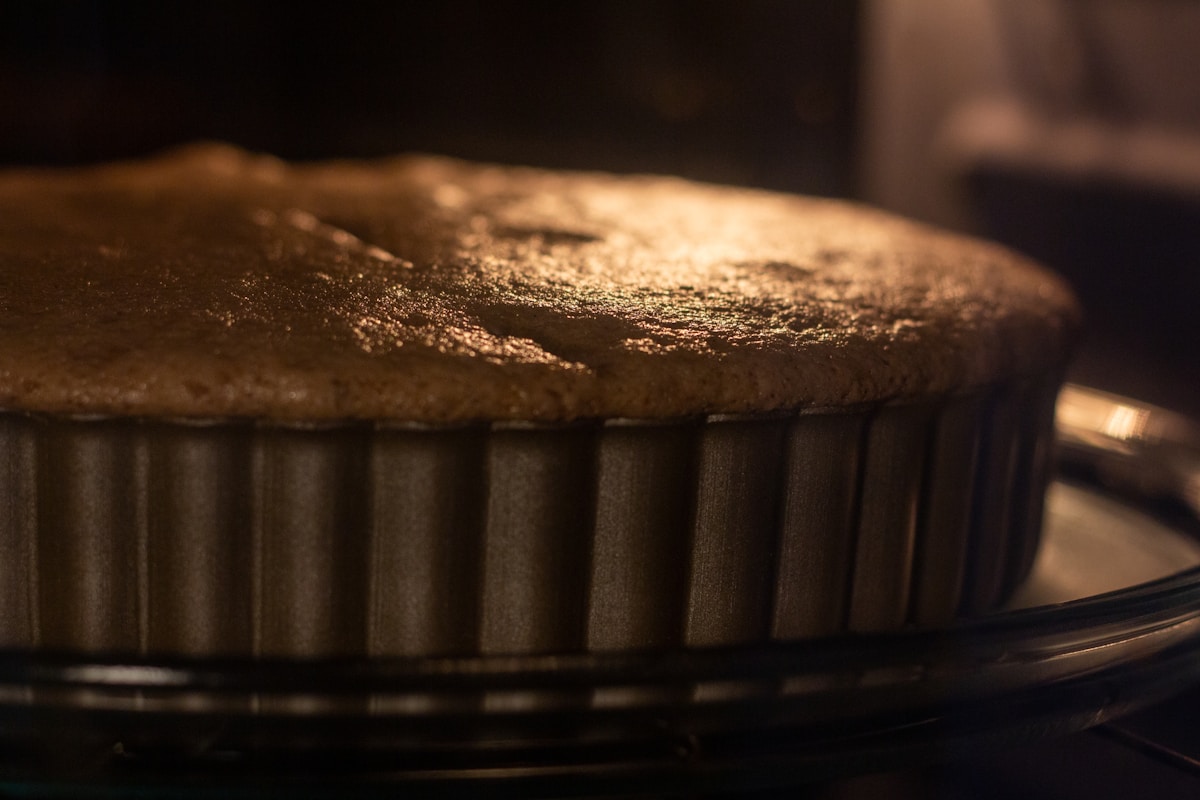
You’ve done everything right. You followed the recipe to the gram, your butter was perfectly room temperature, and you folded the dry ingredients with the care of a surgeon. You divide the batter evenly between three 8-inch pans, slide them into your preheated oven, and set the timer. The dream is a towering, perfectly level three-layer cake.
The reality? When the timer dings, you pull out one layer that’s golden brown, one that’s pale and a little sunken, and one whose edges are threatening to burn while the center is still wobbly. It’s one of the most common frustrations in baking, and it makes you want to throw your spatula across the room. I’ve been there.
The good news is that your recipe probably isn’t the problem. Your oven is. Most home ovens are unruly beasts with hot spots, inaccurate thermostats, and uneven airflow. When you try to bake multiple things at once, you amplify all those problems. But you don’t need a new, expensive oven. You just need a strategy and a couple of smart, affordable tools. Let’s break down how to tame your oven and get those perfect, even layers every single time.
Understanding Your Oven’s Secret Agenda
Before you can fix the problem, you have to understand why it’s happening. Your oven isn’t intentionally trying to ruin your cake; it’s just doing its job inefficiently. Most conventional home ovens in the US have a primary heating element at the bottom and a broiler element at the top. When you set it to bake at 350°F (175°C), that bottom element cycles on and off to maintain the average temperature. This creates two major issues for the multi-layer baker.
First, you get intense radiant heat from the bottom. The rack closest to that element will always be hotter. This is why the bottom of a single cake often gets dark before the top is fully cooked. Second, that heat needs to circulate. This happens through convection—the natural movement of hot air rising and cooler air sinking. When you cram three pans into the oven, you create roadblocks. You effectively block the air from moving freely, creating pockets of super-hot air and other areas that struggle to reach temperature.
You end up with a cake on the bottom rack getting blasted with direct heat, while the cakes on the top rack are shielded from it, relying only on the circulating air. If you place them too close to the oven walls, you can block airflow there, too. The result is a chaotic baking environment where each cake is on its own miserable journey. The key to even baking is to manage that heat and airflow so every pan gets a similar experience.
The Stagger and Rotate The Core Technique
This is the single most important technique, and it costs nothing but a bit of attention. The goal is to give each cake pan as much open space around it as possible and to ensure no single cake spends the entire bake time in a known hot or cool spot. You are manually creating a more even baking environment.
The Setup: If you have two racks, position them in the upper-third and lower-third of your oven. Don’t center them perfectly. You want good vertical separation. Let’s say you’re baking two or three layers:
- Two Layers: Place one pan on the upper rack toward the back left. Place the second pan on the lower rack toward the front right. They should not be directly on top of each other. Imagine looking down through the top of your oven—you should be able to see the bottom element without a pan completely blocking your view.
- Three Layers: This is trickier and requires more space. Place two pans on one rack, leaving at least an inch or two between them and the oven walls. Place the third pan on the other rack, centered between the two pans below (or above) it. Again, the key is to avoid vertical stacking.
The Execution: Baking isn’t a “set it and forget it” activity, especially with multiple layers. You need to intervene halfway through. Look at the total baking time in your recipe. If it says 30 minutes, set a timer for 15.
When that halfway timer goes off, open the oven and work quickly. Here’s the maneuver:
- Rotate: Turn each pan 180 degrees. The part that was facing the back of the oven should now face the front.
- Swap: Move the pan(s) from the top rack to the bottom rack, and the pan(s) from the bottom rack to the top.
This simple two-step process ensures that each layer gets its share of time in the hotter and cooler zones of your oven, and it evens out any browning from the front-to-back temperature differences. Your layers will rise more evenly and bake at a much more consistent rate. (Yes, really. This one trick will improve your cakes by 50%.)
The Right Gear for the Job (Hint It’s Not Expensive)
While technique is king, a few pieces of affordable gear can take your results from good to flawless. I’ve tested countless gadgets, and these are the three that offer the biggest bang for your buck.
1. An Independent Oven Thermometer: This is the most important baking tool you can own, and it costs less than $10. The thermostat on your oven is, to be blunt, a liar. It can be off by as much as 50°F (about 28°C) in either direction. If your recipe calls for 350°F and your oven is actually running at 390°F, your cake edges will burn before the center is set. If it’s running at 310°F, your cake will take forever to bake and may end up dense and gummy.
- What to Buy: Get a simple dial thermometer that can hang from a rack or stand on its own. Brands like Taylor or Rubbermaid are workhorses and cost around $7-$10. There’s no need for a fancy digital one.
- How to Use It: Place it in the center of the oven before you preheat. When your oven beeps to signal it’s preheated, trust the thermometer, not the beep. Adjust your oven dial until the independent thermometer shows the correct temperature.
2. Insulated Cake Strips: Have you ever had a cake that domed significantly in the middle, creating a hill you have to slice off to stack the layers? That happens because the edges of the pan get hot and set the batter long before the center has a chance to finish rising. Cake strips solve this problem completely.
- What They Are: They are fabric bands (usually aluminized cotton) that you soak in cold water and then wrap tightly around the outside of your cake pan. My go-to set is from Wilton, which costs about $12 for a set of four.
- How They Work: The wet fabric insulates the sides of the pan, forcing the cake to bake from the top and bottom more evenly with the center. The result is a stunningly flat-topped cake layer with tender, non-crusty edges. It’s a bit of kitchen magic and saves you the hassle and waste of leveling your cakes.
3. Light-Colored, Heavy-Gauge Aluminum Pans: Not all cake pans are created equal. Those dark, non-stick pans you see everywhere are actually terrible for cakes. Dark surfaces absorb and radiate heat much more aggressively, which leads to—you guessed it—dark, dry, overbaked edges. The thin material also creates hot spots.
- What to Buy: The gold standard for professional and serious home bakers is heavy-gauge, anodized aluminum pans. They distribute heat incredibly evenly for a perfect, uniform crumb. Brands like Fat Daddio’s or Nordic Ware’s Naturals line are the best investment you can make. A set of two 8-inch pans will run you about $20-$25. They’ll last a lifetime and give you far better results than any cheap non-stick alternative. (Your future self will thank you.)
Let’s Bake A Real-World Walkthrough
Theory is great, but let’s put it all into practice. Imagine we’re making a classic vanilla layer cake that needs to bake for 32 minutes at 350°F (175°C).
-
Prep the Oven: Place one rack in the lower-third position and one in the upper-third. Hang your independent oven thermometer from the center of the top rack. Preheat to 350°F, adjusting as needed until the thermometer reads true.
-
Prep the Pans: While the oven heats, soak your cake strips in cold water. Grease and flour three 8-inch light-colored aluminum pans. Wring out the excess water from the strips and wrap them snugly around the pans.
-
Fill and Place: Divide your batter evenly. Place two pans on the bottom rack, one front-left and one back-right. Place the third pan on the top rack, centered in the front. Check for clearance—nothing should be touching.
-
The Halfway Point: Set your timer for 16 minutes. When it beeps, open the door. Move the single pan from the top rack to the bottom-center position. Move the two pans from the bottom rack to the top, placing them front-right and back-left. Rotate each pan 180 degrees as you move it. Close the door.
-
Finish the Bake: Set the timer for another 16 minutes. When it’s done, test for doneness with a toothpick in the center of each cake. They should all be perfectly golden and ready at the same time.
By combining these simple steps, you’ve outsmarted your oven. You’ve created a controlled environment that gives every cake an equal chance to succeed. The result is three beautifully flat, evenly colored, and perfectly baked layers ready for stacking. No more stress, no more waste—just delicious, picture-perfect cake.


