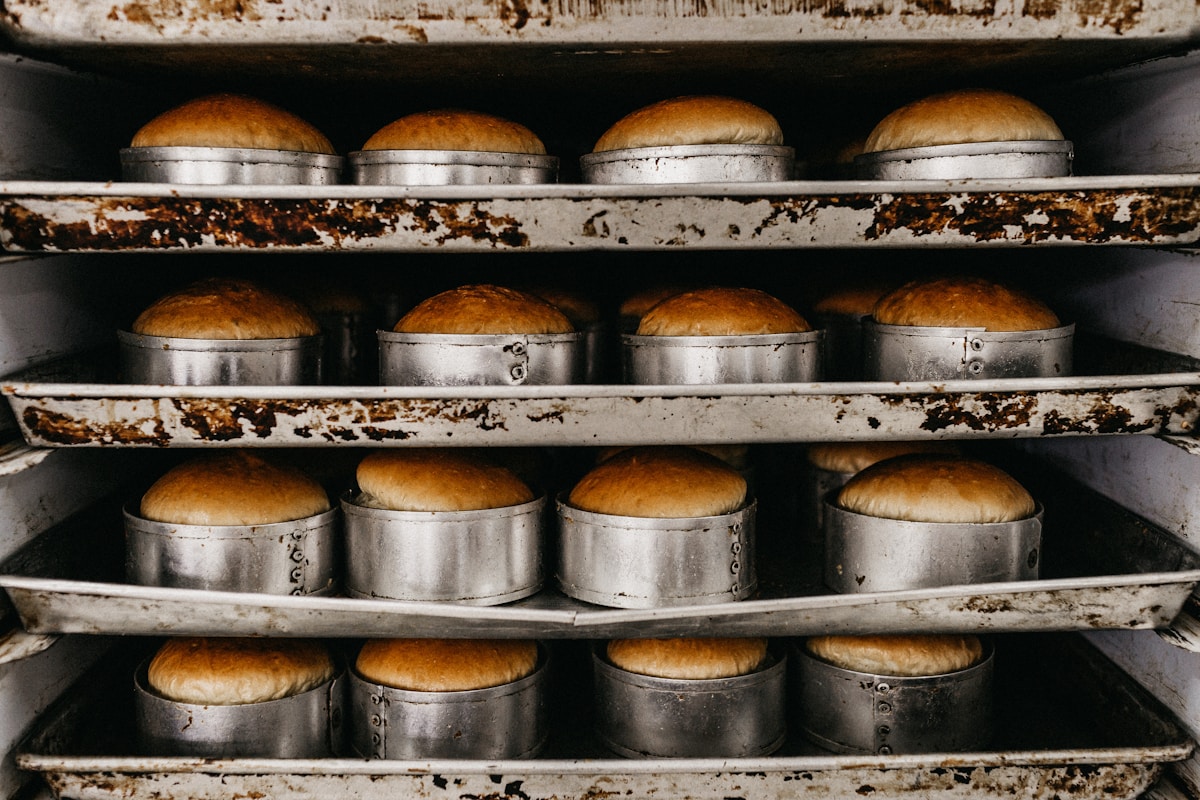
You know the moment. You pull your beautiful cake layers from the oven, only to see it: the dreaded dome. A puffy, cracked mountain rises from the center of each pan, while the edges are thin, dry, and slightly over-baked. You’re now faced with a choice — level it with a serrated knife, wasting a third of your hard work, or stack a wobbly, unstable layer cake that looks like it’s about to fall over.
It’s one of the most common frustrations in baking. You follow the recipe perfectly, but the physics of a hot oven betray you. For years, I saw those little purple fabric strips in baking aisles and wondered if they were just another gadget designed to take up drawer space. They’re called insulated baking strips, or cake strips, and they promise a perfectly flat, even cake every single time. But do they actually work? I bought a set of Wilton Bake-Even Strips, fired up my oven, and put them to the test to find out if they’re a game-changer or just another gimmick.
The Problem Why Your Cakes Dome in the First Place
Before we can fix the problem, we need to understand it. A domed cake isn’t a sign that you did something wrong; it’s a sign that your oven is working exactly as it should. The problem lies in the pan.
Metal cake pans are excellent conductors of heat. When you slide a pan of batter into a preheated 350°F (177°C) oven, the metal sides and bottom heat up almost instantly. This intense, direct heat starts cooking the outer ring of the batter immediately. The proteins in the eggs and flour begin to set, forming a solid crust around the edge of the cake long before the center has even warmed up.
Meanwhile, the batter in the middle of the pan is insulated by all the batter around it. It heats up much more slowly. As it heats, the leavening agents (baking powder or soda) activate, releasing carbon dioxide gas and causing the batter to rise. Since the edges are already set and can’t rise anymore, all that rising action is forced upward and inward, creating that signature dome. By the time the center is finally cooked through, the edges have been baking for much longer, often becoming dry and tough.
In short: your cake cooks from the outside in, and the dome is the evidence. The goal is to get the entire pan of batter to cook at the same rate.
How Insulated Baking Strips Work Their Magic
This is where those simple-looking fabric strips come in. They aren’t made of some space-age material; their magic comes from one of the most basic principles in science: evaporative cooling. (Don’t worry, this is the only science lesson, I promise.)
The instructions are simple: you soak the fabric strips in cold water until they’re saturated, squeeze out the excess so they’re not dripping, and then wrap them snugly around the outside of your cake pan before filling it with batter. Most, like the Wilton ones I used, have little loops to secure them tightly.
Once in the hot oven, the wet strip acts as a cooling insulator for the sides of the pan. As the oven’s heat hits the strip, the water begins to evaporate. This process of evaporation actively pulls heat away from the metal, keeping the sides of the pan significantly cooler than they would be otherwise. This simple action prevents the cake’s edges from setting too quickly.
Because the edges stay cooler for longer, the entire cake — center and sides — heats up and rises at a much more uniform rate. The leavening has time to work its magic across the whole surface of the cake before a crust forms anywhere. The result is a slower, gentler bake that produces a level cake with a soft, tender crumb from edge to edge.
The Test A Side-by-Side Butter Cake Bake-Off
Talk is cheap. The only way to know for sure is to see the results firsthand. I decided to bake two identical 8-inch vanilla butter cakes, a recipe notorious for doming due to its rich, dense batter.
Here was my setup:
- The Recipe: My go-to classic vanilla butter cake.
- The Pans: Two identical 8-inch round aluminum pans.
- The Oven: Preheated to exactly 350°F (177°C), with a rack in the center.
- The Variable: One pan was left bare. The other was wrapped with a water-soaked Wilton Bake-Even Strip.
I prepared the batter, divided it equally by weight between the two pans, and slid them into the oven side-by-side. I baked them for 32 minutes, until a toothpick inserted into the center came out clean.
The difference was visible even before I took them out of the oven. The cake in the bare pan had risen dramatically in the center, already showing a pronounced dome. The cake with the baking strip looked… well, flat. Almost perfectly flat.
After letting them cool for 15 minutes, I turned them out onto a wire rack. The results were undeniable:
-
Cake #1 (No Strip): A significant dome, about an inch high at its peak. The edges were a darker golden-brown and felt firm to the touch. To stack this layer, I’d have to trim off the entire dome, resulting in a lot of wasted cake (or, let’s be honest, baker’s snacks).
-
Cake #2 (With Strip): Astonishingly level. There was a tiny, almost imperceptible rise in the very center, but it was functionally flat and ready to stack right out of the pan. The color was a uniform pale gold all the way across, and the edges were just as soft and springy as the middle. The cake also seemed slightly taller overall, as the rise was distributed evenly instead of being concentrated in one spot.
The Verdict Are Wilton Strips Worth the Money?
After my test, the answer is a resounding yes, but with a few conditions. A set of two Wilton strips for 8-inch or 9-inch pans costs about $12. Let’s break down the value.
Pros:
- Perfectly Flat Tops: This is the main promise, and they deliver 100%. No more wobbly, unstable layer cakes.
- No Wasted Cake: You don’t have to level your cakes, which means you get to use every last crumb you baked. Over time, this could even be a small cost savings.
- More Tender Crumb: Because the edges don’t over-bake, you get a cake that is moist and tender from the center all the way to the edge. No more dry, crusty rings.
- Reusable and Durable: They’re made of heat-safe fabric and can be used over and over again. They’re a small one-time investment.
Cons:
- Another Gadget: If your kitchen drawers are already overflowing, this is one more thing to store.
- Extra Prep Step: Soaking and attaching the strips adds about two minutes to your prep time. It’s minimal, but it’s not nothing.
- Can Increase Bake Time: Because you’re slowing down the cooking process, I’ve found cakes with strips can sometimes take 5-10 minutes longer to bake through. You have to rely on your toothpick test, not just the timer.
For roughly the price of a few fancy coffees, you’re buying consistency. If you bake layer cakes frequently or sell your baked goods, these are a non-negotiable tool. The time saved from leveling and the professional quality of the result are easily worth the small price tag.
The DIY Alternative Can You Make Your Own?
Of course, the internet has a DIY solution for everything. The most common one involves folding several layers of paper towels to the height of your pan, soaking them in water, and wrapping them in a layer of aluminum foil. You then wrap this homemade strip around your pan.
Does it work? Yes, it can. It operates on the exact same principle of evaporative cooling. However, I’m not a huge fan, and here’s why.
First, it’s wasteful. You’re using up paper towels and foil every time you bake. Second, it can be messy and less effective. It’s difficult to get a perfectly uniform thickness, and if there are gaps, you can get uneven results. Finally, while generally safe, having paper in a hot oven, even when wet, just feels a little less secure than using a purpose-built, fire-retardant fabric tool. For a one-off project, it’s a fine hack. But if you’re baking regularly, the convenience and reliability of the real thing are superior.
Lucas’s Final Take Who Really Needs These?
So, should you run out and buy insulated baking strips?
Buy them if:
- You are a serious home baker who loves making multi-layer cakes for birthdays and holidays.
- You value precision and consistency in your results.
- The frustration of domed, wasted cake is something you want to eliminate forever.
- You want a more tender cake crumb from edge to edge.
Skip them if:
- You mostly bake sheet cakes, cupcakes, or bundt cakes where a perfectly flat top isn’t critical.
- You are a casual baker who only makes a layer cake once or twice a year.
- You’re on a very tight budget and don’t mind the DIY paper towel method.
Ultimately, insulated baking strips fall into my favorite category of kitchen gear: an inexpensive, specialized tool that solves one specific, annoying problem perfectly. They aren’t essential for survival, but for anyone who takes pride in the craft of baking a beautiful layer cake, they are one of the best value-for-money upgrades you can make to your toolkit. (Your future, less-frustrated self will thank you.)