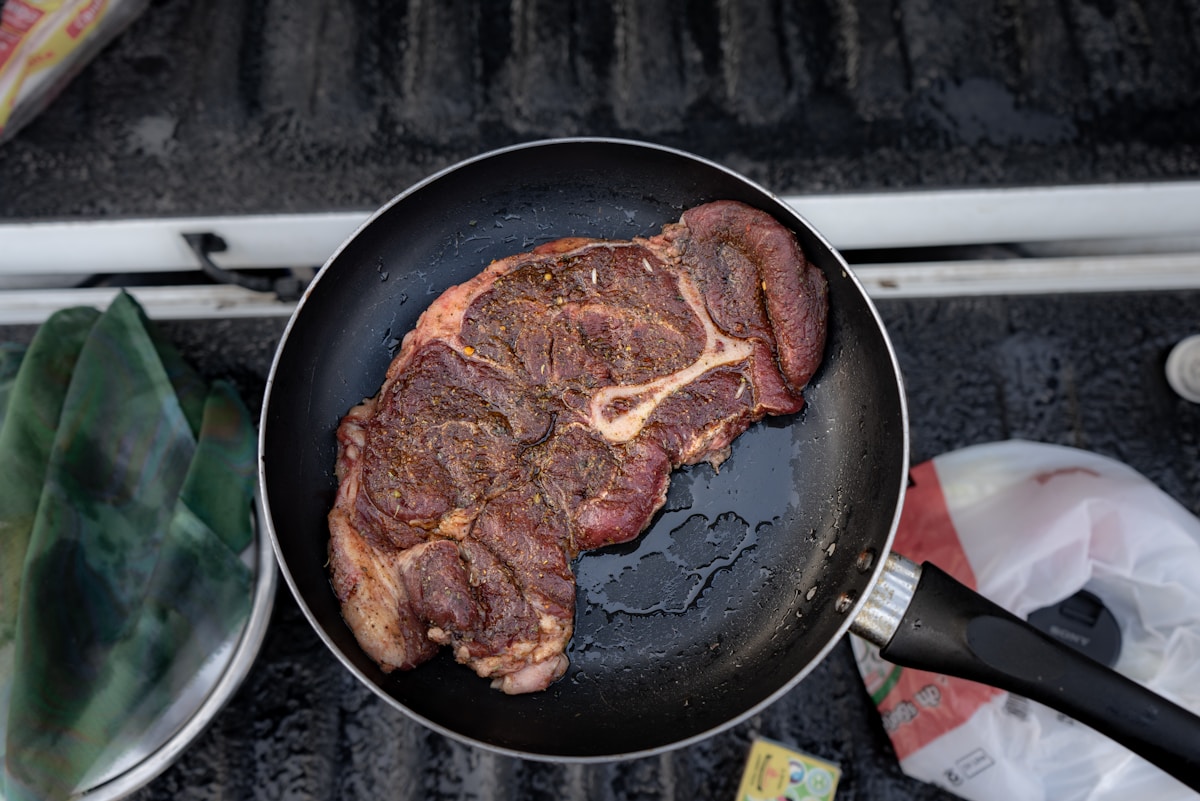
Have you ever done this? You buy a beautiful, thick-cut steak. You’re picturing that perfect restaurant steakhouse crust—deeply brown, sizzling, and promising a world of flavor. You get your pan hot, you toss it in… and what you pull out a few minutes later is… well, it’s grey. And maybe a little tough. And definitely not the steak of your dreams.
If you’re nodding your head, please know you are not alone. This is one of the most common kitchen frustrations, and it has absolutely nothing to do with you being a “bad cook.” It’s just a little bit of science getting in the way. But the good news is, once you understand the why, the how becomes incredibly simple. Together, we’re going to banish the grey steak from your kitchen for good.
The Real Enemy of a Good Sear is Water
Let’s get the big secret out of the way first: a beautiful, brown crust cannot and will not form in the presence of moisture. It’s physically impossible.
When you put a wet or even slightly damp steak into a hot pan, the first thing the pan’s energy does is boil off that surface moisture. It’s essentially steaming your steak. By the time the water is gone, the muscle fibers have already started to cook and tighten, turning that familiar shade of grey. You’ve missed the window for a great sear.
What you’re aiming for is something called the Maillard reaction. This sounds like a complicated term from a chemistry textbook, but it’s the most delicious science you’ll ever learn. It’s the cascade of chemical reactions between amino acids and reducing sugars that happens when food is exposed to high heat. It’s responsible for the flavor and color of everything from toasted bread and roasted coffee to, you guessed it, a perfectly seared steak.
Think about it this way: trying to sear a wet steak is like trying to make toast out of damp bread. You won’t get a toasty, brown surface; you’ll just get warm, soggy bread. To get that Maillard magic, you need two things: high heat and a dry surface.
Your First Mission: Before you do anything else, take your steak out of the package and pat it completely, obsessively dry with paper towels. I mean it. Pat the top, the bottom, the sides. Use more paper towels than you think you need. The drier the surface, the faster you’ll get that gorgeous, flavorful crust. (Your future self will thank you.)
Choosing Your Tools for Victory
You don’t need a kitchen full of expensive gadgets to cook a great steak, but the right pan makes a world of difference. Your thin, non-stick skillet from college is not the hero we need for this job.
What you need is a pan that holds heat incredibly well. When you place a cool steak onto its surface, you want the pan to stay scorching hot, not instantly cool down. This is why heavy-bottomed pans are king.
-
Cast Iron Skillet: This is the undisputed champion of searing. A well-seasoned cast iron pan (like a classic from Lodge, which is surprisingly affordable) gets blazingly hot and stays that way. It distributes heat evenly and will give you a crust so good you’ll write home about it. They require a little care, but they will last literally forever.
-
Carbon Steel Pan: Think of this as cast iron’s lighter, more responsive cousin. It heats up and cools down faster but still holds enough heat for a fantastic sear. Many professional restaurant kitchens swear by them.
-
Heavy-Bottomed Stainless Steel Pan: If you have a high-quality, heavy stainless steel pan (from a brand like All-Clad, for example), this will also work beautifully. The key word is heavy. A thick aluminum or copper core sandwiched between steel will ensure it retains enough heat for the job.
What About Oil? You also need an oil with a high smoke point. This means it can get very hot before it starts to smoke and burn, which would impart a bitter taste to your steak. Olive oil is wonderful for many things, but its smoke point is too low for a proper sear.
Instead, reach for:
- Avocado oil (smoke point around 520°F / 271°C)
- Grapeseed oil (smoke point around 420°F / 216°C)
- Canola oil or other neutral vegetable oil (smoke point around 400°F / 204°C)
You only need a thin layer—just enough to coat the bottom of the pan.
The Step-by-Step Path to a Perfect Crust
Alright, your steak is dry and your pan is ready. Let’s walk through the process. It’s simpler than you think. This method works beautifully for a 1 to 1.5-inch thick steak like a New York strip, ribeye, or sirloin.
1. Season Generously (and at the Right Time): There’s a lot of debate about when to salt a steak. The simplest, most foolproof method for a beginner is to salt it right before it goes into the pan. If you salt it too early (say, 30 minutes ahead) and don’t pat it dry again, the salt will draw moisture to the surface, sabotaging your sear. So, right after you’ve patted it dry for the final time, season it liberally with coarse salt (like kosher salt) and freshly ground black pepper. Don’t be shy! A lot of it will fall off in the pan.
2. Get That Pan Screaming Hot: Place your pan over medium-high heat. Let it preheat for a good 3-5 minutes. Then add your high-smoke-point oil. How do you know when it’s hot enough? The oil should shimmer and flow like water. If you see a tiny wisp of smoke, that’s your green light. (Yes, really.)
3. The Sizzle is Your Reward: Gently lay your steak in the pan, placing it away from you to avoid any oil splattering your way. You should immediately hear a loud, aggressive sizzle. If you hear a gentle fizzle, your pan isn’t hot enough. Take the steak out and wait for the pan to get hotter. That initial sizzle is the sound of success.
4. Do Absolutely Nothing: This is the hardest part. Once the steak is in the pan, do not touch it. Don’t poke it. Don’t lift a corner to peek. Don’t shake the pan. Just let it be. Let it sit there for 2-4 minutes, depending on the thickness, allowing that glorious Maillard reaction to do its work undisturbed.
5. The One and Only Flip: After a few minutes, use a pair of tongs to flip the steak. You should see a deep, rich brown crust. Now, sear the other side for another 2-4 minutes.
6. The “Fancy Restaurant” Finish (Optional but Recommended): About a minute before your steak is done, you can add a tablespoon of butter, a smashed clove of garlic, and a sprig of thyme or rosemary to the pan. As the butter melts and foams, tilt the pan towards you and use a spoon to continuously baste the steak with that fragrant, sizzling butter. It adds a layer of flavor that is simply divine.
7. Check for Doneness: The most reliable way to know if your steak is done is with an instant-read meat thermometer.
- Rare: 125°F / 52°C (cool red center)
- Medium-Rare: 135°F / 57°C (warm red center)
- Medium: 145°F / 63°C (warm pink center)
- Medium-Well: 150°F / 66°C (slightly pink center)
- Well-Done: 160°F+ / 71°C+ (very little or no pink)
Remember, the steak’s temperature will rise a few degrees as it rests. Pull it from the pan when it’s about 5 degrees below your target temperature.
The Most Important Step You’re Probably Skipping
You did it! The steak is cooked, it looks amazing, and you’re ready to dig in. But wait! There is one final, non-negotiable step: resting your steak.
When you cook meat, the muscle fibers tighten up and push all the delicious juices toward the center. If you slice into it immediately, all those juices will pour out onto your cutting board, leaving you with a dry, less flavorful steak.
You must let it rest on a cutting board or plate for 5-10 minutes. During this time, the muscle fibers relax, and those precious juices redistribute evenly throughout the meat. Think of it like a sponge. If you squeeze a saturated sponge, water gushes out. If you let it sit, the water stays locked inside. A rested steak is a juicy steak. Tent it loosely with a piece of aluminum foil to keep it warm.
Try This Tonight
Feeling ready to conquer the grey steak? Here’s a simple plan.
Go to the store and buy one nice, 1-inch thick New York strip or sirloin steak. Pick up a bag of pre-washed salad greens and your favorite dressing. That’s it.
When you get home, follow the steps. Take a deep breath. Pat the steak dry. Season it. Get your heaviest pan hot. Listen for that sizzle. Flip it just once. Let it rest while you toss your salad. Slice the steak against the grain, serve it next to the salad, and take a bite.
You’re not just making dinner; you’re learning a skill. It might not be perfect the first time, and that is completely okay. But it won’t be grey. And with every steak you cook, you’ll get more confident. Everyone starts somewhere, and tonight, you’re starting with a delicious, perfectly seared steak. You’ve got this.