A Reddit Post That Hit Home
Last week, a Reddit user in the r/food community shared a photo of scallions chopped by their six-year-old. The pile was a glorious mess — some pieces were perfect rings, others were barely nicked, and a few were practically minced into oblivion. The caption was simple: “My 6-year-old helped with dinner tonight.” The comments section exploded, but not with criticism. Instead, dozens of parents chimed in with stories of their own children’s chopping adventures, each one celebrating the beautiful imperfection of little hands learning a big skill.
If you’ve ever handed a knife to a child, you know that feeling: equal parts pride and terror. You want them to learn, to feel capable, to contribute. But you also want all ten fingers to stay attached. So what can you realistically expect from a six-year-old wielding a blade? Let’s break it down by safety, skill, and sanity.
When Should You Start Teaching Knife Skills?
The American Academy of Pediatrics suggests that children around age 5 or 6 can begin using a child-safe knife under direct supervision. Before that, let them tear lettuce, snap green beans, or use a plastic serrated “salad chopper” on soft items. The key is readiness — not just age, but attention span and impulse control. If your child can follow a two-step instruction like “keep your fingers curled and cut away from your body,” they’re probably ready.
Start with a nylon or plastic knife (like the Kuhn Rikon Kid-Kutter or Opinel’s Le Petit Chef line). These cut through soft foods like cucumber, banana, or zucchini without risking serious cuts. Wait until age 7 or 8 before introducing a small paring knife with a sharp blade — and only after they’ve mastered the safety basics.
The Single Most Important Safety Rule: The Claw Grip
Before your child even touches a knife, teach them the “claw grip.” Show them how to curl their fingertips under, tucking their thumb behind the knuckles, so the blade slides against the flat of their fingers. Practice with a wooden spoon or a piece of play dough. Make it a game: “Let’s see if you can keep your knuckles in front of the blade like a shield.”
Then, demonstrate the “bridge grip” for small foods: pinch the item with your thumb and forefinger, forming a bridge over the top, and cut through the open space. This works well for cherry tomatoes or mushrooms.
Set clear boundaries: the knife stays at the cutting board, no running with a blade (even a plastic one), and always cut away from your body. Repeat these rules every single time you cook together. (Your future self will thank you.)
What Realistic Chopping Looks Like at Age 6
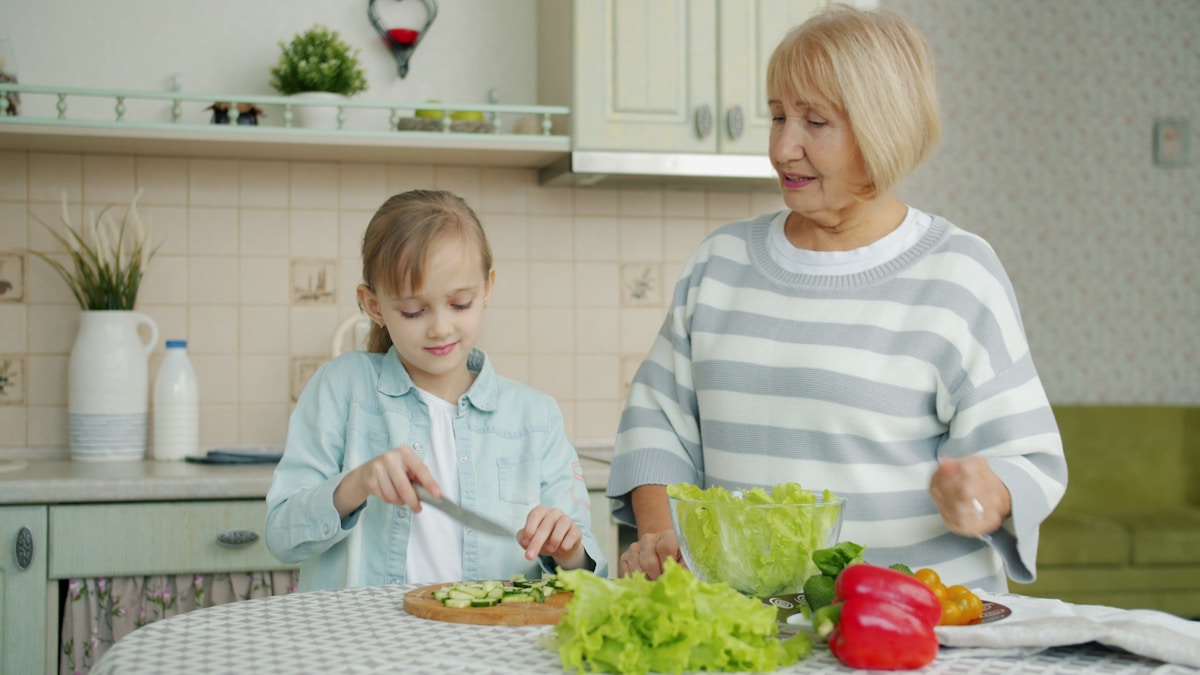
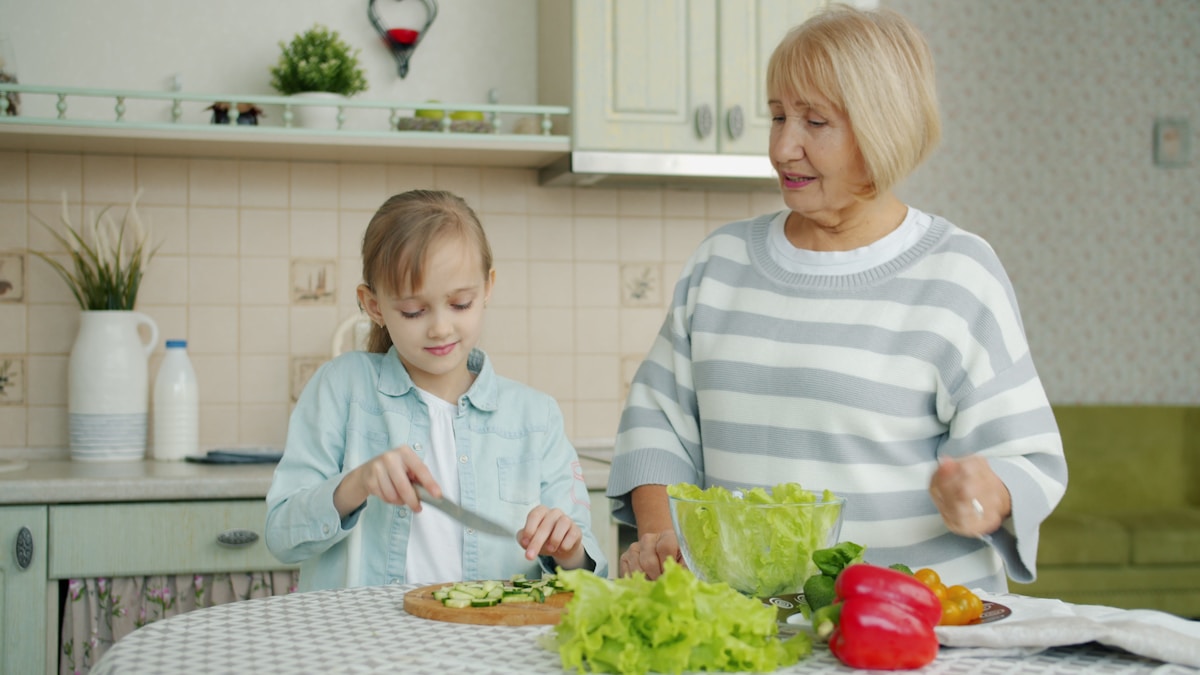
Let’s be honest: a six-year-old’s scallions won’t look like a line cook’s. You’ll get odd-sized pieces, some nearly whole, some crushed. And that’s perfectly fine. The goal at this stage is not precision — it’s building muscle memory, confidence, and a positive association with cooking.
What they can do:
- Cut soft, uniform items like strawberries, bananas, peeled cucumber, or mushrooms into chunks.
- Use a crinkle cutter (like the Wavy Chopper from Tovla Jr.) to make fun zigzag shapes — this is a huge hit with kids.
- Slice soft herbs like basil or cilantro by stacking leaves and using a rocking motion with a nylon knife.
- Spread butter or soft cheese with a table knife.
What they probably can’t do yet:
- Dice an onion into even cubes (the tear factor and fine coordination are too much).
- Slice a raw potato (too hard for a nylon knife; wait for a sharp blade).
- Julienne carrots (requires advanced finger control).
The key is to match the task to the tool. A crinkle cutter gives satisfying results with little risk. A nylon knife works wonders on ripe avocado. Let them master the easy stuff before moving to harder produce.
A Safe Progression Plan: From Soft to Hard
Think of knife skills like learning to ride a bike. You don’t start on a steep hill; you start on a flat driveway with training wheels. Here’s a rough roadmap:
Ages 4–5: Use a plastic serrated knife (like the Curious Chef set) on very soft foods like bread, cheese, or peeled peaches. Focus on holding the knife correctly and keeping the other hand clear.
Ages 6–7: Introduce a nylon blade (Kuhn Rikon or Opinel) for firm but yielding foods: bell peppers, cooked carrots, stone fruits, celery. Teach the claw grip. Accept irregular sizes.
Ages 8–9: Move to a small, sharp paring knife (3–4 inch blade) under direct supervision. Practice on mushrooms, zucchini, or boiled potatoes. Start teaching the “slide and chop” technique where the tip stays on the board.
Ages 10+: If they’ve shown consistent safety, let them use a chef’s knife (8-inch) with a proper grip. Supervise until they can slice a whole onion without a trip to the ER.
Each child is different. Some six-year-olds have the fine motor control of an eight-year-old; others need more time. Watch their frustration level. If they’re struggling, step in or offer a different task. The goal is joy, not tears.
Practical Tips for Parents (From Someone Who’s Been There)
I remember the first time my nephew helped me make salsa. He was six, and I gave him a plastic knife and a bowl of cherry tomatoes. He stabbed one, squirted juice across the counter, and declared himself a “master chef.” The tomatoes were a pulpy mess, but you know what? That salsa was the best I’d ever tasted — because he made it.
Here are a few hacks I’ve learned along the way:
- Use a damp paper towel under the cutting board to keep it from slipping. (Safety first, even with plastic knives.)
- Buy a pair of cut-resistant gloves for kids (like NoCry or Dex Fit). They’re cheap, washable, and give you peace of mind.
- Start with produce that has a natural “guide” — like cucumber slices that are already round. All your child has to do is halve them.
- Let them practice on Play-Doh or modeling clay first. It sounds silly, but it builds the right muscle movements without any risk.
- Celebrate the uneven piles. Take a photo. Post it on social media just like that Reddit parent did. The mess is proof of effort.
The Real Lesson: Patience and Process Over Perfection
What that Reddit post really captured is the beauty of letting kids participate, even when the results are far from perfect. The comments were full of parents saying things like “My almost-8-year-old still cuts bananas into uneven lumps, but she beams with pride.” That pride is the whole point.
When you teach a child to use a knife, you’re not just teaching a cooking skill. You’re teaching them that they are capable. That mistakes are okay. That dinner is something we create together, not something that just appears. And that even a messy pile of scallions can be a triumph.
So next time your six-year-old asks to help chop, take a deep breath, hand them the nylon knife, and show them the claw grip. Then step back and let them try. Will it be perfect? No. Will it be worth it? Absolutely. (Your kitchen counter might need a wipe-down, but your family dinner table will be richer for it.)
Happy cooking, and remember — every great chef started with a very, very uneven slice.