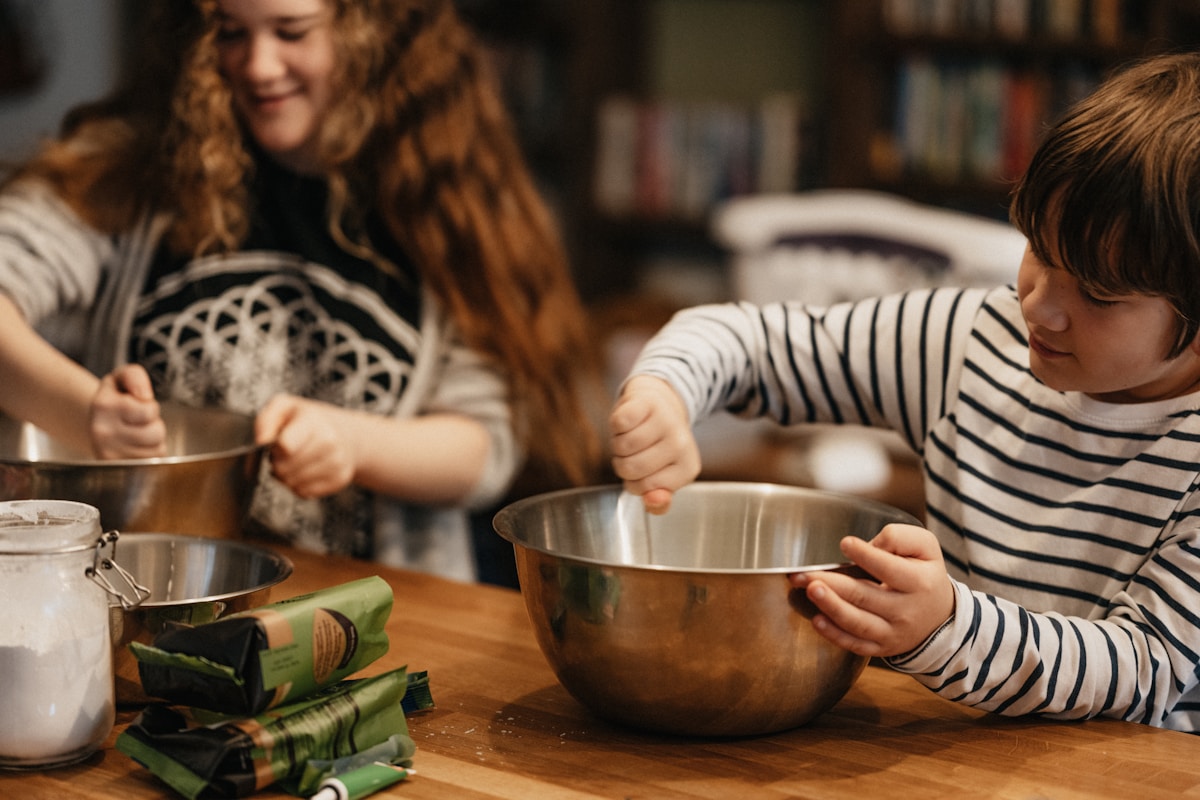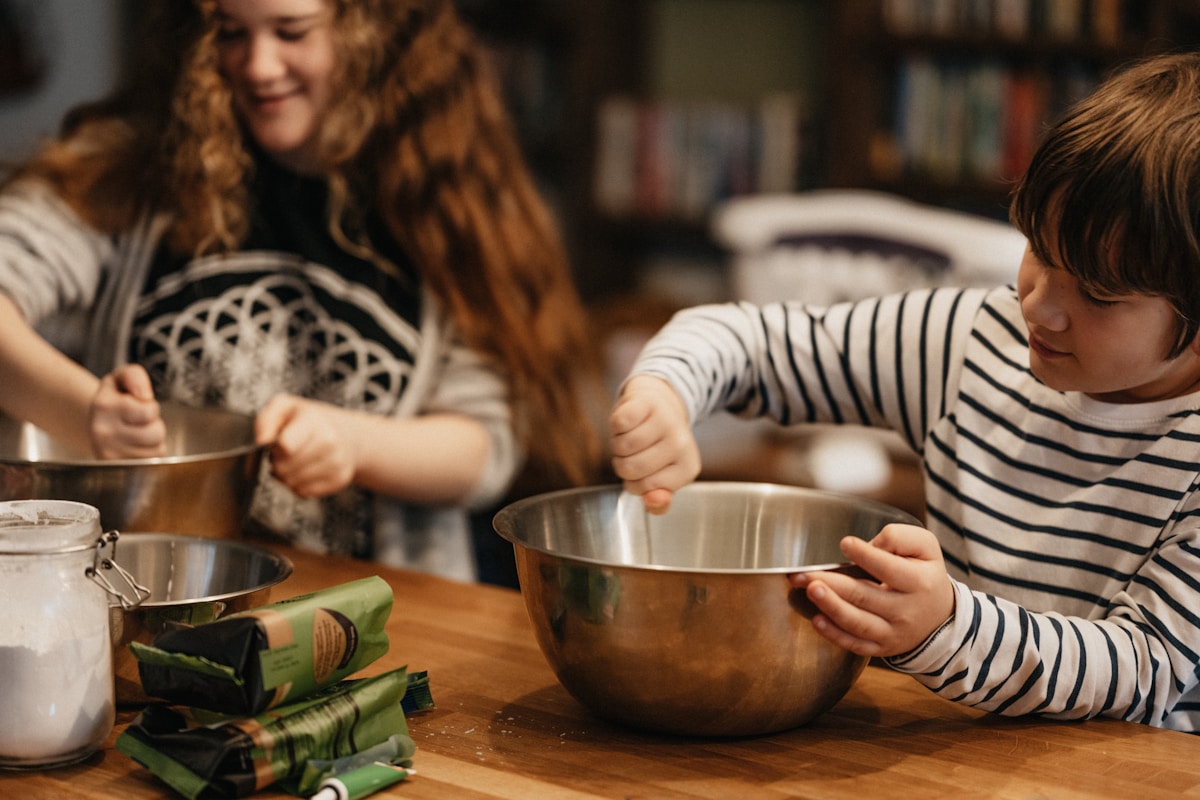
A child walks into the kitchen just as the pasta water starts bubbling. You want to say yes when they ask to help, but dinner is already moving, the counter is crowded, and everyone is hungry.
The easiest way to let kids help cook dinner without creating chaos is to give them one small, clearly defined job. Choose a forgiving meal, prepare the ingredients first, keep heat and sharp tools under adult control, and let your child work on a no-heat part of dinner while you handle time-sensitive steps.
Key Takeaways
- Give your child one small, visible task instead of responsibility for the whole meal.
- Prepare the workspace first, and keep knives, heat, raw meat, raw eggs, and hot cookware under adult control.
- Use short, no-heat jobs with clear endpoints to reduce spills, waiting, and frustration.
- Encourage children to smell, describe, or taste food without pressure to take a bite.
- Make one simple cleanup task part of the same family cooking routine.
Choose a forgiving dinner with separate child and adult jobs
A flexible meal works better than a recipe with several delicate steps. If one ingredient is measured imperfectly or your child loses interest halfway through, dinner can still come together. Pasta with vegetables, meatballs, and fruit is a useful example because it naturally separates into small jobs, but the same approach works for tacos, grain bowls, sandwiches, soup, or a simple tray meal.
Before inviting your child into the kitchen, divide the meal into two lists:
- Child-led jobs: Measure dry ingredients, stir a cool mixture, tear herbs or lettuce, wash produce with supervision, assemble toppings, mash soft foods, or place prepared ingredients into a bowl.
- Adult-led jobs: Handle knives, raw meat, raw eggs, hot oil, boiling water, stovetops, ovens, hot trays, and final seasoning.
Give your child one small component as a project rather than responsibility for the whole dinner. For example, your child might prepare the fruit plate, mix a cool sauce, or arrange toppings while you cook the pasta and meatballs.
Expect participation to add a few minutes, especially while your child is learning. The goal is not to make dinner faster than it would be alone. The goal is to create a repeatable family cooking routine that fits into real evenings.
Set up the kitchen before inviting your child in
A little preparation prevents much of the waiting, grabbing, and spilling that makes cooking with children feel difficult. Read the recipe first and identify jobs that can happen away from heat and sharp tools.
On a busy evening, gather ingredients and measure some of them before calling your child over. You do not need to prepare every step in advance. Simply placing the mixing bowl, measuring spoons, towel, and child-sized portion of ingredients within reach can make the activity feel organized.
Try this quick setup:
- Clear one stable work area away from the stove.
- Put a large bowl on the counter so stirring is less likely to splash.
- Set out only the ingredients needed for the child’s task.
- Keep knives, graters, raw meat, raw eggs, hot cookware, and appliances under adult control.
- Place a towel nearby for small spills.
- Have your child wash their hands before handling food, and wash produce as appropriate according to current food-safety guidance.
- Give your child a starting job immediately.
A clear first job is especially helpful for young children. Instead of saying, “You can help somehow,” try, “Please put these three washed strawberries in the bowl,” or, “Can you stir this cool sauce ten times?” A specific beginning reduces waiting and makes success easier to see.
If you use a step stool or special kitchen tool, check that it is stable and suitable for your child and the workspace. No product removes the need for close adult supervision. Keep handles turned away from the edge, and keep the child away from places where a hot pan, boiling liquid, or appliance cord could be pulled down.
Match safe kitchen jobs to your child’s abilities
Age labels are useful starting points, not fixed rules. Children develop coordination, attention, and judgment at different rates, and caregivers have different comfort levels. Choose tasks based on your child’s actual ability and your ability to supervise actively.
Many preschool-age children can try these easy tasks for young cooks with close supervision:
- Wash fruits or vegetables at the sink.
- Tear lettuce, soft herbs, or other suitable ingredients into small pieces.
- Measure dry ingredients with help leveling a spoon or cup.
- Pour pre-measured ingredients into a large bowl.
- Stir a cool mixture with a sturdy spoon.
- Mash soft foods with an appropriate utensil.
- Sprinkle cheese, herbs, or other toppings.
- Assemble a plate or arrange fruit.
- Carry lightweight, unheated ingredients a short distance.
- Set napkins or place unbreakable tableware.
For cooking with a 5-year-old, these jobs are often more manageable than asking the child to follow an entire recipe. You can say, “You are in charge of mixing the dressing,” while you remain responsible for preparing ingredients and checking the final result.
Direct adult supervision is needed around knives, graters, heat, hot liquids, electrical appliances, and slippery surfaces. An adult should handle boiling water, hot oil, stovetops, ovens, hot pans, and hot trays. Keep children away from oven doors, burner controls, and pan handles that could be reached or pulled.
Raw meat and raw eggs also need careful handling. For a simple family routine, it is usually easiest for the adult to portion, mix, shape, and cook these ingredients. If a child touches raw ingredients, follow current food-safety guidance for handwashing, preventing cross-contamination, cleaning food-contact surfaces, and keeping ready-to-eat foods separate.
Do not assume that a child knife, blunt tool, or new gadget is automatically safe. Suitability depends on the child, the task, the setup, and active supervision. When in doubt, choose a no-heat, no-knife job.
Keep the routine moving when attention runs out
Children often lose interest before dinner is ready. That does not mean the cooking activity failed. Build the routine so your child can stop without holding up the meal.
Use short jobs with visible endpoints. “Stir until the ingredients look combined” may feel vague, while “Stir ten times, then we will check it together” gives the child a finish line. Other useful endpoints include adding three toppings, tearing one handful of herbs, or arranging six pieces of fruit.
Offer a choice between two safe tasks rather than opening a long negotiation. You might ask, “Would you rather mix the sauce or arrange the fruit?” Both choices move dinner forward, and your child gets some control.
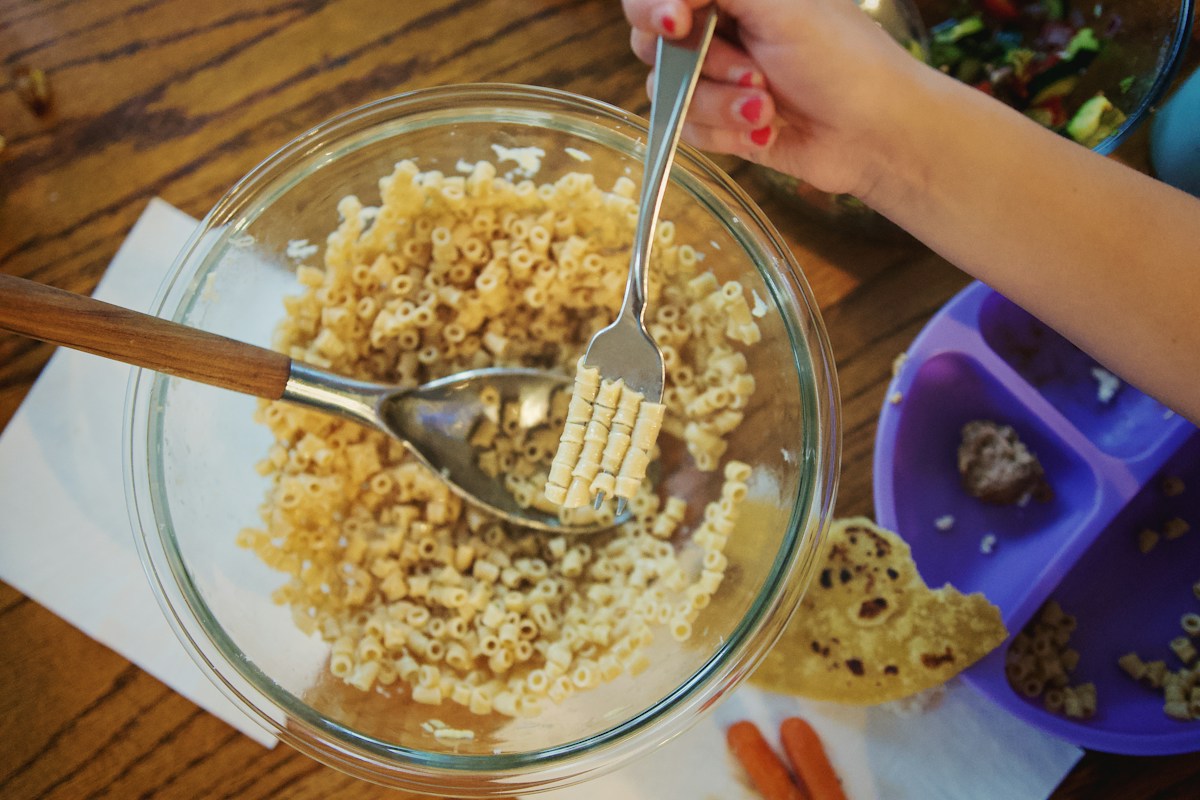
A small child-sized portion can also prevent delays. If you are making pasta with vegetables and meatballs, let your child assemble a small bowl of cooked pasta with a few prepared vegetables while you finish the adult portion. The child can help choose toppings, but the adult should remain responsible for cooking foods thoroughly and serving them safely.
During time-sensitive steps, give your child a no-heat activity. While you drain pasta or move a hot tray, your child can set napkins, sort washed fruit, place spoons on the table, or choose between two serving bowls. This keeps them involved without requiring them to wait beside a hot surface.
Use bowls that are wide and stable, and fill them only with an amount your child can comfortably manage. Smaller portions of ingredients mean fewer spills and less frustration. Keep one towel within reach and treat wiping a small spill as part of the process rather than a disaster.
Some nights are simply not good nights for cooking together. If your child is overtired, hungry, or upset, it is reasonable to cook independently and invite participation another time. A family cooking routine works best when it is manageable, not mandatory every evening.
Use one family dinner as a set of small projects
A pasta-style dinner shows how to divide child-friendly dinner prep without turning the meal into a recipe lesson.
Before cooking: An adult gathers the ingredients, washes produce as appropriate, and prepares any cutting. The child can place fruit in a bowl, tear washed herbs, or measure a dry ingredient into a separate cup.
While the adult cooks: The child can stir a cool sauce, sprinkle prepared vegetables into a bowl, or assemble a topping station. The adult handles boiling pasta water, cooking meatballs, moving pans, and checking the hot food.
Before serving: The child can arrange fruit, put grated cheese or herbs into small bowls, and carry lightweight, unheated items to the table. The adult portions hot food and checks that the meal is ready to serve.
This division gives the child a meaningful role without requiring them to manage dangerous or time-sensitive steps. It also allows the meal to keep moving if the child needs a break.
Encourage tasting without turning dinner into a test
Helping prepare food may make a child curious about it, but it cannot guarantee that they will taste or enjoy it. Keep participation separate from eating.
Invite your child to smell an herb, touch a piece of washed produce, describe a sauce, or taste a small amount if they want to. Try phrases such as, “Would you like to smell the basil?” or, “You can decide whether you want some on your plate.” Avoid treating a bite as proof that the cooking activity worked.
When practical, serve at least one familiar food with less familiar foods. In the pasta example, fruit or plain pasta may be familiar even if the vegetables or sauce are new. Let the child assemble a portion with choices from the meal, while the adult remains responsible for safe cooking and serving.
Praise specific participation instead of promising a reward for eating. “You kept the bowl steady while you stirred” or “You remembered to put the measuring cup in the sink” reinforces useful skills without pressure, bribery, or shame.
Make cleanup part of the family cooking routine
Cleanup is easier when it starts before the meal reaches the table. Give your child one simple job that does not involve sharp tools, hot cookware, raw-food residue, or cleaning products.
Suitable jobs may include putting measuring cups in the sink, returning unopened ingredients to their place, wiping a safe section of the counter with a damp cloth, or carrying napkins to the table. Stay nearby and keep expectations short.
Use the same closing sequence each time:
- The adult turns off heat and moves hot items out of reach.
- The adult handles knives, hot cookware, raw-food residue, and cleaning products.
- Scraps go into the appropriate bin or bowl.
- The child returns safe tools or places them by the sink.
- The adult washes or loads tools and cleans food-contact surfaces according to current food-safety guidance.
- The child helps wipe a safe area or set the table.
- Everyone briefly names one thing they contributed.
End with encouragement, not a performance review. “You helped make the fruit plate” is enough. The routine is successful when your child participates safely, dinner gets served, and the kitchen is ready for the next meal.
FAQ
What can a 5-year-old do to help cook dinner?
A 5-year-old may be able to wash produce with supervision, tear greens or herbs, measure with help, stir a cool mixture, mash soft foods, sprinkle toppings, arrange fruit, and set the table. Choose tasks according to the child’s coordination, attention, maturity, and your ability to supervise.
How do you cook with a child without making dinner take much longer?
Prepare the workspace first, give the child one small project, and use no-heat tasks while you handle time-sensitive cooking. A separate child-sized portion or component can be paused if attention fades. Expect a few extra minutes while skills are developing rather than trying to make the activity as fast as solo cooking.
What kitchen tasks should adults handle when children help cook?
Adults should control or closely supervise knives, graters, stovetops, ovens, boiling liquids, hot oil, hot pans, hot trays, electrical appliances, raw meat, and raw eggs. The adult should also handle final food-safety checks, serving hot food, and cleanup involving sharp tools or raw-food residue. Current USDA or FDA guidance can help you review food-handling practices for your household.