


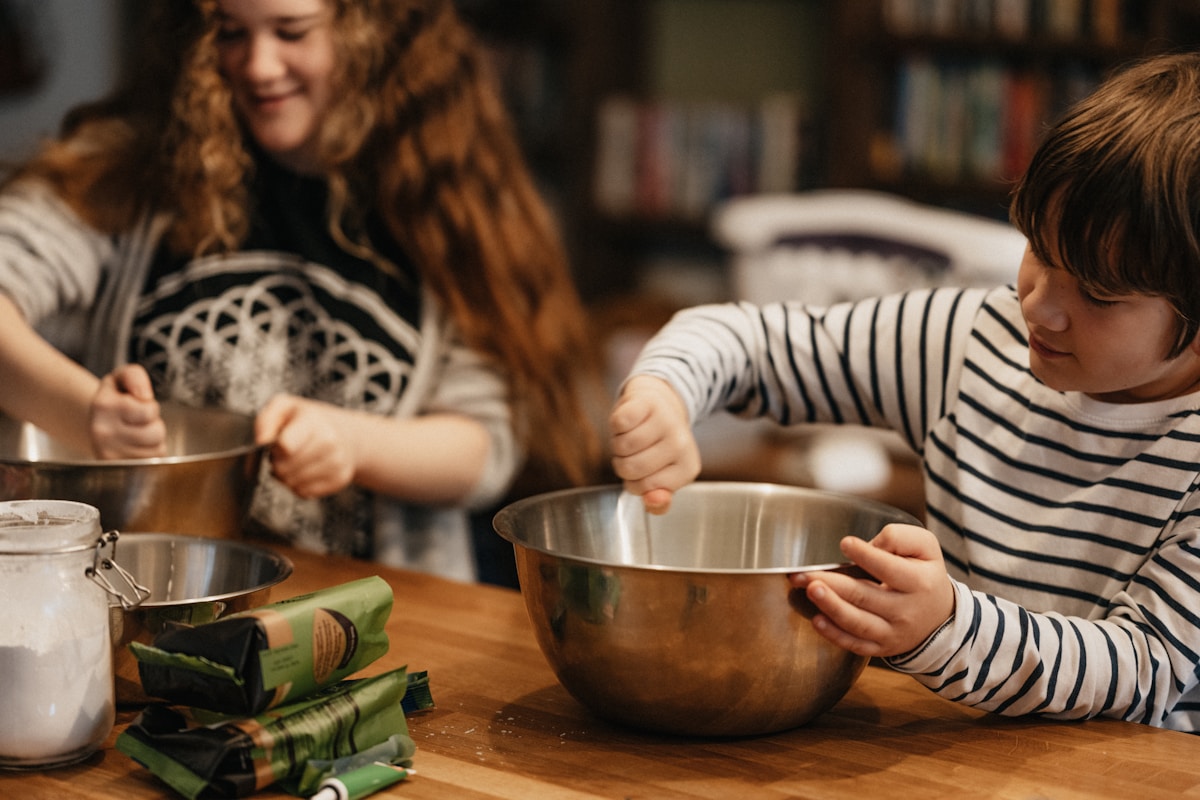
Dinner is already moving fast when your 7-year-old pulls up a chair and asks, “Can I do it?” It is a sweet moment—until flour hits the floor, the recipe has several steps going at once, and you find yourself taking back the spoon.
Cooking with a 7 year old does not mean handing over an entire recipe or asking them to watch from the sidelines. The most successful approach is shared cooking: you plan the flow and manage higher-risk steps while your child owns one or two useful jobs that genuinely move the meal forward.
Key Takeaways
- Give your child one or two real jobs per recipe instead of expecting them to make the whole meal.
- Choose short, forgiving recipes with frequent actions and visible progress.
- Keep heat, sharp tools, hot liquids, raw meat, and heavy cookware adult-led unless you have decided a closely supervised task is appropriate.
- Set up the workspace before cooking, then use one clear instruction at a time.
- Step in immediately for safety; for ordinary mistakes, coach briefly and hand the task back.
Start With a Shared-Recipe Mindset, Not a Solo-Cooking Test
A successful cooking session is not measured by whether your child can make dinner independently. It is measured by whether they felt useful, practiced a manageable skill, and stayed safely involved from beginning to end.
At age 7, readiness varies widely. One child may patiently measure and follow two directions in a row, while another may be eager but need a reminder after each small step. Coordination, attention span, kitchen experience, and the ability to pause when asked all matter more than age alone.
Give your child ownership without giving them the whole recipe. Before you start, choose one or two jobs that are genuinely needed, such as measuring flour, tearing basil, stirring muffin batter, or assembling taco fillings.
Try saying, “I’m in charge of the hot parts. You’re in charge of measuring the spices and mixing the sauce.” That clear division prevents the frustrating feeling that you are both reaching for the same bowl.
Cooking with a 7 year old works best when the adult plans the flow while the child owns specific parts of the recipe. Your child learns that cooking is a series of useful jobs, not a performance that has to be perfect.
Choose Recipes That Give Kids Quick, Visible Wins
The best easy recipes for kids to make are short, forgiving, and active. Look for a few ingredients, repeated actions, and something your child can see changing right away.
Assembly-style meals are especially helpful because there is less waiting. Your child can spread, sprinkle, layer, fold, and arrange while you handle any heat or sharp tools needed behind the scenes.
Save long recipes with multiple pans, tight timing, hot oil, lots of raw animal foods, or delicate techniques for another day. Those meals can leave a child waiting around and may make you feel rushed enough to take over.
These family cooking night ideas offer clear jobs and a visible finish:
- Quesadillas: Your child can sprinkle cheese, add cooked fillings, fold tortillas, and help plate the finished wedges. An adult manages the hot pan.
- Oven fries: Wash potatoes together. After the adult cuts them, your child can toss the pieces with oil and seasoning in a large bowl and spread them on a tray. The adult handles the oven and hot tray.
- Muffins: A child can place paper liners in the pan, measure many dry ingredients, stir gently, and add berries or toppings. Use a large bowl to contain enthusiastic stirring.
- Simple pasta sauce: A child can wash produce, tear herbs, measure dried seasonings, and add ingredients when invited. Keep stirring near heat adult-led unless you decide a particular moment is suitable for close supervision.
- Pita pizzas, wraps, tacos, and snack plates: These are ideal for spreading, sorting, making choices, and arranging food. They can also help picky eaters feel more comfortable trying a meal they helped build.
Use this quick first-recipe check: Can my child do something every few minutes? Can they see what their job changed? Can I manage the hot or complicated parts without rushing? If the answer is yes, it is probably a good choice.
Divide Every Recipe Into Child Jobs and Parent-Only Jobs
Before pulling out ingredients, make a quick job map. Read the recipe once, circle your child’s jobs, and name your own jobs out loud. This takes only a couple of minutes and prevents disappointment halfway through when your child assumes they will be doing everything.
The chart below offers examples, not rules. Use your judgment about your child’s maturity and the food, tools, and kitchen setup in front of you.
| Recipe stage | Meaningful jobs a 7-year-old may do with guidance | Parent-only or parent-led jobs |
|---|---|---|
| Before cooking | Wash hands, gather ingredients, wash produce, read short steps aloud, measure dry ingredients, tear herbs | Check recipe timing, open difficult packages, manage sharp tools and heavy equipment |
| Prep | Mash soft foods, stir, season, assemble, place muffin liners in a pan, sort ingredients | Cut hard foods, use sharp knives, handle raw meat, drain hot foods |
| Cooking | Watch for changes, help set a timer, add pre-measured ingredients when invited | Use burners, ovens, hot pans, boiling water, hot oil, and heavy cookware |
| Serving and cleanup | Set the table, add cold toppings, portion cold foods, wipe the workspace, sort utensils, help store food with direction | Lift hot dishes and make decisions about cooking, cooling, and storage |
These kids cooking tasks by age are best treated as a starting point, not a checklist to complete. A child who is tired, distracted, or new to the kitchen may need simpler jobs than they did last week.
Choose jobs that matter. Setting out napkins is helpful, but measuring cumin for taco filling builds a stronger sense of contribution because your child can taste the result later.
Rotate tasks over several cooking sessions. On taco night, your child might first wash lettuce and sprinkle cheese. Next time, they can measure seasonings or make a topping bowl. Familiar recipes make it easier to add one new skill without overwhelming them.
Set Up a Safer, Calmer Workstation Before the First Ingredient
Much of calm cooking happens before the first ingredient is opened. Set up a child station in a stable spot where your child can reach comfortably without stretching over a hot surface or crowded counter.
Use a secure step stool or an appropriately sized work surface. Place a damp towel under a cutting board or mixing bowl to reduce sliding, and keep a small bowl nearby for peels, wrappers, and scraps.
If a recipe has many ingredients, pre-measure some adult-only parts before inviting your child in. This is not cheating; it prevents the shared experience from becoming a race against a boiling pot or an oven timer.
Begin with handwashing, tie back long hair, and move loose sleeves, cords, bags, and clutter away from the work area. Keep sharp tools, hot cookware, hot liquids, raw animal foods, and electrical appliances outside your child’s station unless you are actively supervising a task you have decided is suitable.
Give one instruction at a time. “Fill this cup to the half-cup line” is easier to follow than “Measure the flour, add it, stir twice, and get the cinnamon.” When the first job is complete, offer the next one.
Plan for mess rather than hoping there will be none. Put a tray or baking sheet under the mixing bowl, choose a bowl larger than you think you need, and keep a cloth ready for spills. Wiping a spill can simply become the next job: “The sugar escaped. Let’s clean our station so we can keep going.”
For knives, heat, appliances, raw foods, and food storage, follow current food-safety guidance and the instructions for your own equipment. When in doubt, keep the task adult-led and give your child a nearby role, such as measuring, timing, seasoning, or plating.
Teach Without Stepping In Too Fast
It can be surprisingly hard to watch a child stir slowly or sprinkle cheese in one big pile. But uneven stirring and imperfect assembly are often where learning happens.
Pause before correcting anything that is not a safety issue. Ask yourself, “Will this make the food unsafe or truly ruin the recipe?” If not, let the moment continue for a few seconds.
Use language that gives guidance without taking ownership away:
- “What do you notice about the batter now?”
- “Would you like to try again, or would you like me to hold the bowl while you stir?”
- “Your job is to get the cheese across the tortilla. It does not need to look the same every time.”
- “I’ll handle the hot pan. You can tell me when the timer rings.”
- “That scoop is a little full. Let’s level it together, then you can pour it in.”
A simple intervention rule helps: step in immediately for safety. For ordinary mistakes, offer one small cue, demonstrate once if needed, and hand the task back.
If measuring goes wrong, avoid silently fixing it whenever possible. If your child spills a little flour outside the bowl, clean it up together and continue. If the amount is clearly too far off, say, “We need one more small scoop to reach the line,” rather than, “You did that wrong.”
Mess is often the biggest source of parent takeover. Contain it, accept a reasonable amount, and make cleanup part of the recipe’s ending. A child who helps wipe the counter and return ingredients learns that cooking includes caring for the workspace.
Impatience usually means there is too much waiting. Give a waiting job: set the table, make a topping bowl, choose herbs to tear, count muffin liners, or draw a quick menu sign for family cooking night.
Build Kitchen Skills One Small Win at a Time
Repeating a familiar recipe is one of the kindest ways to build confidence. Your child does not need a brand-new challenge every weekend; they need enough familiarity to notice, “Last time I needed help, and this time I did it myself.”
A gentle progression for teaching kids kitchen skills can look like this:
- First sessions: Washing produce, measuring, stirring, seasoning, and assembling.
- Next sessions: Reading short recipe steps, portioning ingredients, setting timers, and preparing soft foods with an adult-selected tool and close guidance.
- Later sessions: Taking charge of a larger cold-prep or assembly section, such as building wraps, mixing a salad, or preparing pizza toppings while an adult manages heat and higher-risk steps.
Keep sessions short enough that everyone can finish with a good feeling. If dinner is hectic, invite your child to do just one job instead of trying to create a full lesson. Measuring shredded cheese for quesadillas still counts as cooking together.
After the meal, take two minutes for a recap. Ask, “What felt easy?” “What felt tricky?” and “What job do you want to try next time?” Their answer helps you choose the next small challenge.
The goal is not a miniature adult chef. A calm shared meal, repeated over time, builds independence more reliably than expecting a 7-year-old to perform every step perfectly.
FAQs
What kitchen tasks can a 7-year-old usually do?
Many 7-year-olds can help wash produce, measure ingredients, stir, mash soft foods, tear herbs, add seasonings, assemble meals, set timers with help, and clean their workspace. Choose tasks based on your child’s attention, coordination, and ability to follow directions, not age alone.
Can a 7-year-old use a knife or the stove?
Knife and heat tasks require individualized adult judgment and close supervision. Sharp knives, burners, hot pans, boiling water, hot oil, ovens, and heavy cookware are best kept adult-led unless you have determined that a specific supervised task is appropriate for your child and your equipment. Your child can still have an important role by measuring, timing, seasoning, or plating.
What are the easiest recipes for kids to make with a parent?
Start with quesadillas, muffins, oven fries, pita pizzas, tacos, wraps, snack plates, or simple pasta sauces. These recipes have short steps, clear visual results, and meaningful jobs that do not require your child to manage heat or complicated timing.


