There are few things more satisfying than pulling a tray of perfectly golden shortbread from the oven. And when you’ve taken the time to press delicate, colorful flower petals onto each one, the anticipation is even greater. You imagine the floral scent, the buttery crumble… but then you see it. The cookies are perfect, but the beautiful petals are scorched, brown, and bitter.
It’s a common and frustrating problem for anyone venturing into the art of baking with botanicals. The good news is that you’re not doing anything wrong, and your oven isn’t necessarily broken. You’ve just run into a small but significant chemistry problem. Baking, after all, is chemistry you can eat, and today we’re going to solve this specific equation.
The Science of the Scorch Why Petals Burn
To understand the solution, we first have to understand the science. A cookie dough and a flower petal are fundamentally different materials, and they react to heat in vastly different ways.
Your cookie dough is a beautiful emulsion of fat, sugar, and flour, with a significant moisture content locked within. The butter and sugar provide insulation, allowing the dough to heat up relatively slowly and bake evenly. This gradual heating process allows for two key reactions: the Maillard reaction and caramelization, which together create that irresistible golden-brown color and complex flavor.
An edible flower petal, on the other hand, is incredibly thin and has a very low moisture content. When it enters a hot oven—say, 350°F (175°C)—any moisture it holds evaporates almost instantly. With no water left to absorb the thermal energy, the petal’s temperature skyrockets. The delicate sugars and proteins within it undergo the Maillard reaction and caramelization at an accelerated, uncontrolled rate. Before your cookie is even halfway baked, the petal has already burned.
Think of it like toasting a slice of thick, moist brioche versus a paper-thin wafer. The wafer will turn black in seconds under the same heat that gently toasts the brioche. (Chemistry is a stubborn thing.) The direct, radiant heat from your oven’s top heating element is the primary culprit, targeting the exposed surface of the cookie where the flowers sit.
A Methodical Approach for Perfect Petal Shortbread
To counter this, we need to control the heat and protect the petals. Let’s work with a simple, reliable shortbread recipe that provides the perfect canvas. The key is in the technique, not a complex ingredient list.
Base Shortbread Recipe:
- 1/2 cup (113g) unsalted butter, softened to about 65°F (18°C)
- 1/4 cup (50g) granulated sugar
- 1/2 teaspoon pure vanilla extract
- 1 1/4 cups (150g) all-purpose flour (I prefer King Arthur Unbleached for its consistency)
- 1/4 teaspoon fine sea salt
- About 1/4 cup of fresh, clean edible flower petals (dandelions, violas, pansies)
The Technique:
- In the bowl of a stand mixer fitted with the paddle attachment, or with a hand mixer, cream the softened butter and sugar on medium speed until light and fluffy, about 3 minutes.
- Beat in the vanilla extract.
- In a separate bowl, whisk together the flour and salt. With the mixer on low, gradually add the dry ingredients to the butter mixture until just combined. Do not overmix; stop as soon as the flour disappears.
- Roll the dough between two sheets of parchment paper to a thickness of 1/4-inch (about 6mm). Chill the dough slab for at least 30 minutes. (Your future self will thank you for this step, as it prevents spreading.)
- Preheat your oven, but not to your usual temperature. We’ll cover that in the next section.
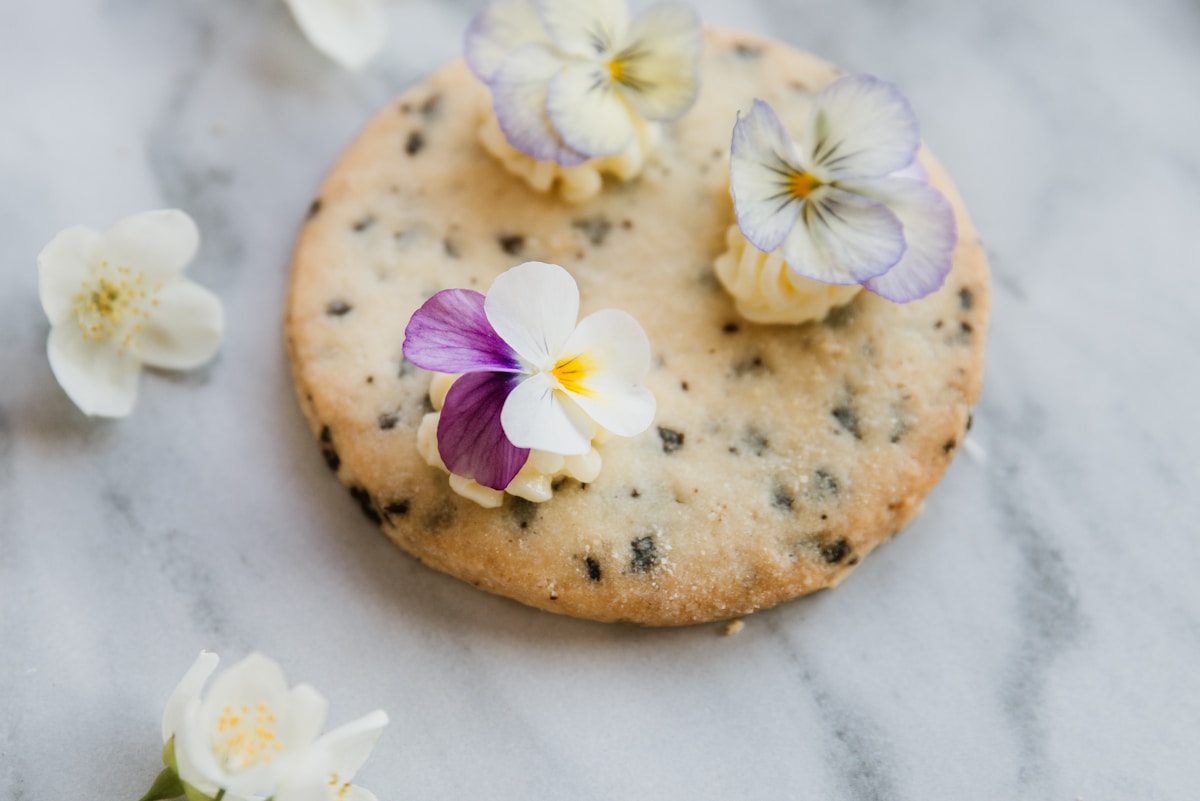
- Cut out your cookies and place them on a parchment-lined baking sheet. Now, for the crucial step: gently press your flower petals onto the surface of the unbaked cookie dough. Don’t mix them into the dough, as this buries some and exposes others unevenly. A light press is all you need to make them adhere.
Mastering Your Oven’s Heat Two Techniques
This is where we solve the burning problem. We will manipulate the baking environment to be gentler on our delicate additions.
Technique 1: Lower and Slower
Instead of the standard 350°F (175°C) for shortbread, you are going to lower the temperature. Preheat your oven to 325°F (165°C).
This seemingly small change of 25°F makes a huge difference. It reduces the intensity of the radiant heat, giving the cookie dough time to bake through more gently. The petals will still toast, but they are far less likely to scorch before the cookie is done.
With this lower temperature, you’ll need to extend the baking time. Bake for 14-18 minutes, or until the edges are just beginning to turn a very light golden. The centers should still look pale. They will firm up as they cool on the tray.
Technique 2: The Parchment Shield (The Ultimate Hack)
This is my favorite trick for guaranteed success, especially if your oven has aggressive top-down heat. It acts as a diffuser.
Bake the cookies at 325°F (165°C) as described above. Watch them closely. About halfway through the bake, around the 8-10 minute mark when the cookies have set but are not yet browned, take a second sheet of parchment paper and gently lay it over the top of the cookies on the baking sheet. It doesn’t need to be tucked in; just let it rest on top.
This simple shield blocks the direct radiant heat from hitting the flowers. The ambient heat in the oven will continue to bake the cookies to perfection, but the petals will be protected from the intense, direct blast that causes them to burn. Continue baking for another 5-7 minutes with the shield in place. The result? Perfectly baked cookies and vibrant, beautifully preserved flowers.
Beyond Dandelions Extending the Technique
These principles apply to almost any delicate edible flower. Here are a few things to keep in mind for others:
- Pansies and Violas: These have larger, flatter petals. Press them gently to ensure the entire flower makes contact with the dough. The parchment shield is particularly effective here.
- Lavender Buds: These are more robust but can become bitter if they toast too much. Use them sparingly, as their flavor is potent, and stick to the lower-and-slower method.
- Rose Petals: Use smaller, fresh petals. They hold up reasonably well, but the parchment shield will preserve their delicate color beautifully.
Ultimately, the key is to remember you’re managing two separate baking processes simultaneously: one for the hearty dough and one for the fragile petal. By lowering the temperature and shielding the surface, you create an environment where both can finish perfectly at the same time. No more burnt botanicals, just beautiful, delicious, and impressive treats.