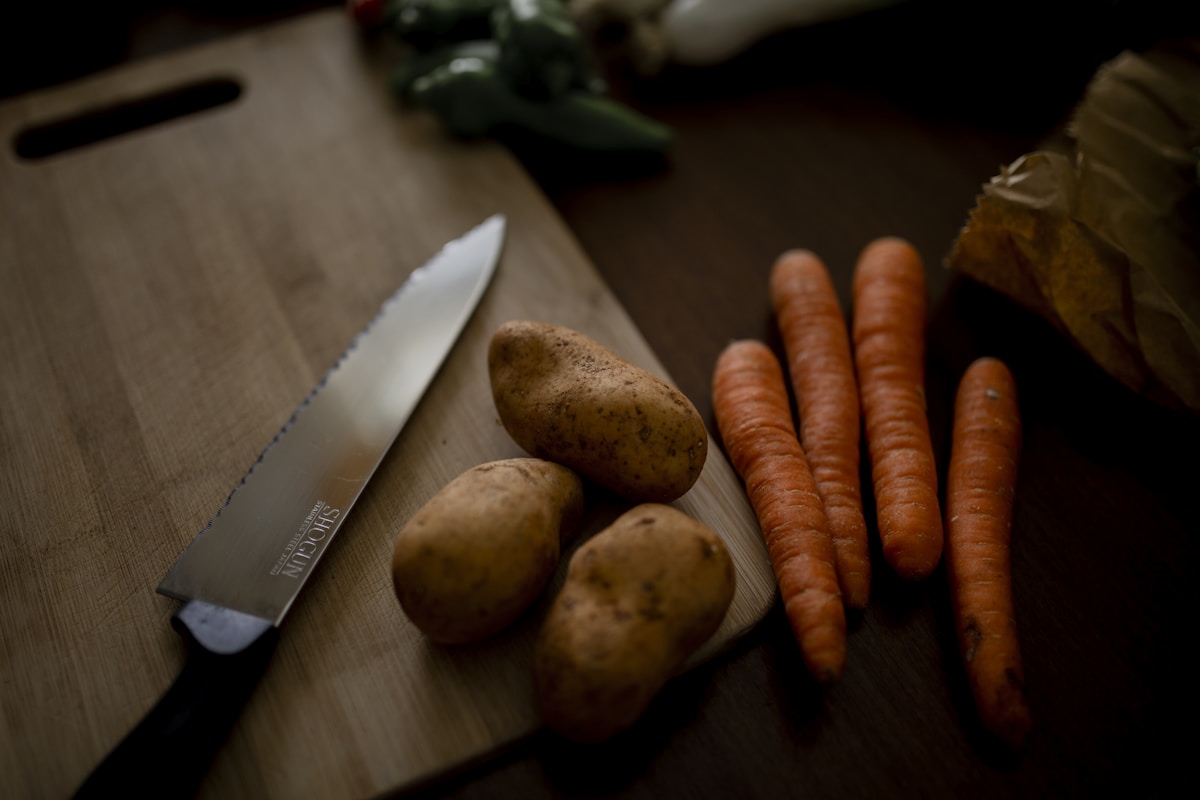
We’ve all been there. You’ve got a beautiful, big potato on your cutting board. You place your very sharp knife on top, ready to make that first cut, and… it wobbles. It tilts. It threatens to roll right off the board and take a finger with it. Your heart does a little jump, and suddenly, making dinner feels less like a joy and more like a high-stakes dare.
Take a deep breath. This is one of the most common moments of kitchen anxiety, and it’s not your fault! Round things just want to roll; it’s their nature. But what if I told you there’s a single, incredibly simple trick that professional chefs learn on day one to solve this problem forever? It’s a technique that turns any wobbly vegetable into a perfectly stable, safe-to-cut block in seconds.
This isn’t about fancy knife skills or years of practice. It’s about understanding a basic principle of gravity, and once you see it, you’ll never look at a carrot or a butternut squash the same way again. Let’s tame that wobble together.
The One Golden Rule Your Cutting Board Is Begging You to Follow
The most important rule of knife safety isn’t about how you hold the knife (though that matters!) or how fast you chop. The number one rule is this: never cut an unstable object.
Think about it like this: would you rather sign your name on a flat, sturdy desk or on a basketball? The desk, of course. Your pen is precise and controlled on the stable surface. The basketball would send your signature into a wobbly mess. Your knife and that potato are exactly the same. The rolling vegetable is your basketball; it’s an unpredictable surface that makes precise, safe cuts nearly impossible.
The goal, then, is to turn that basketball into a desk. And we do that by creating one single, reliable flat surface. This is the foundation of everything. Once your ingredient is stable on the cutting board, you are in complete control. The fear vanishes and is replaced by confidence. (Yes, really.)
Your Step-by-Step Guide to Taming the Wobble
Ready for the magic trick? Let’s grab a potato, a large carrot, or a zucchini and walk through this together. It’s a process you’ll memorize after doing it just once.
Step 1: The Setup First, make sure your workspace is secure. Is your cutting board slipping around? Place a damp paper towel or a piece of non-slip shelf liner underneath it. A sliding cutting board is just as dangerous as a rolling vegetable. Now, grab your go-to knife. A good 8-inch chef’s knife is perfect for this job.
Step 2: The Grip Hold the vegetable securely on the board with your non-knife hand. Curl your fingertips under your knuckles, like you’re making a gentle claw. This is called the “claw grip,” and it protects your fingertips by keeping them tucked safely away from the blade. Your knuckles will act as a guide for the side of the knife blade.
Step 3: The Magic Slice Now for the most important part. Carefully slice a thin piece off one of the long sides of the vegetable. You’re not trying to cut a huge chunk off; you’re just shaving a sliver from one side to create a flat edge. Think of it like taking the peel and a tiny bit of flesh off, from end to end. The piece you slice off can be tossed in your stock bag or compost bin.
Step 4: The Flip and Lock Lift the vegetable and place it on the board with its new flat side facing down. Give it a little push. See that? It doesn’t move. It doesn’t roll. It is now a stable, solid block, completely under your control. Congratulations! You just performed the single most important safety technique in vegetable prep. (Your future self will thank you.)
From Stable to Sliced From Planks to Perfect Dice
Now that your vegetable is secure, the fun begins. You can proceed with any cut you want with total confidence. Here’s the logical progression for turning that stable block into a beautiful, uniform dice, perfect for soups, stews, or roasting.
-
Cut Planks: With the flat side down, slice the vegetable lengthwise into even, flat planks. The thickness depends on what you’re making. For a rustic stew, you might want thick 1/2-inch (about 1.25 cm) planks. For a quicker-cooking hash, you might go for 1/4-inch (about 0.6 cm) planks.
-
Cut Sticks (Batons): Take a few of those planks and stack them neatly on top of each other. Now, slice them lengthwise again to create sticks. If you cut your planks 1/2-inch thick, cut your sticks 1/2-inch wide. Now you have perfect little batons.
-
Cut Dice: Gather up your sticks and line them up. Turn them 90 degrees and chop them crosswise at the same width. If your sticks were 1/2-inch by 1/2-inch, your final cut will create a perfect 1/2-inch dice. Voila! Uniform pieces that will cook evenly and look fantastic.
Does This Work for Everything Round and Awkward?
Absolutely! This “create a flat surface” principle is your universal key to unlocking safe prep for all sorts of tricky produce. The application just changes slightly depending on the shape.
- Potatoes & Sweet Potatoes: The classic example. This technique works perfectly every time.
- Butternut Squash: This is the big boss of wobbly vegetables. Peel the whole squash first. Then, cut it where the thin neck meets the round, bulbous bottom. Now you have two more manageable pieces. Apply the flat-surface technique to each piece individually before proceeding.
- Onions: Onions are a special case, but the principle holds. Instead of slicing a piece off the side, you simply slice the onion in half from the root to the tip. Place each half cut-side-down, and you have two perfectly stable domes to work with.
- Apples & Pears: Need to core and slice an apple? Cut it in half, then place the flat side down to safely cut out the core and make your slices.
- Carrots, Zucchinis, & Cucumbers: For these long, cylindrical veggies, the thin slice off the side is the perfect way to get them to behave on the board.
The Most Important Tool (It’s Not Just the Knife)
We’ve talked a lot about the technique, but it’s powered by two key pieces of equipment: your knife and your board.
Your knife must be sharp. I know it sounds counterintuitive, but a dull knife is far more dangerous than a sharp one. A dull blade requires you to use more pressure, which means when it finally does slip (and it will), it does so with much more force. A sharp knife glides through food with minimal effort, giving you more control. You don’t need a twenty-piece knife block. One great 8-inch chef’s knife, like a Victorinox Fibrox Pro (an amazing and affordable starter knife) or a Wüsthof Classic, will handle 90% of your kitchen tasks.
And as we mentioned before, your cutting board needs to be stable. A heavy wooden board is fantastic because it’s less likely to move and is kinder to your knife’s edge. A good-quality plastic board is also great. Just make sure it’s not warped and that you anchor it with a damp towel if it slides.
Try This Tonight
Feeling ready to give it a go? Here’s your mission. You don’t even need a recipe. Tonight, just grab one potato. That’s it. Place it on your secure cutting board. Hold it with your claw grip and carefully slice one thin piece off the side. Flip it onto its new flat base and give it a push. Feel how solid that is?
Take a moment to appreciate that feeling of control. Then, just for practice, slice it into a few planks, stack them, and cut them into sticks. You don’t have to cook them (though you can certainly roast them with a little olive oil and salt!). The goal is just to build the muscle memory. You just took a giant leap forward in your kitchen confidence, and it all started with one simple, magic slice.