Let’s be honest for a second. Have you ever stood over a cutting board, staring at a wobbly, round onion, and felt a tiny wave of panic? Your knife feels awkward, the onion keeps trying to roll away, and visions of perfectly diced vegetables on cooking shows just make you feel… slow. If you’ve ever felt this, please know you are in excellent company. Every single person who cooks with confidence started right there, with that same wobbly onion.
The secret isn’t buying a hundred-dollar knife or having some kind of natural talent. The secret is learning to make friends with your knife. It’s about understanding a few core ideas that turn a scary tool into your most trusted kitchen partner. Today, we’re going to forget about lightning-fast chopping and focus on the three foundational skills that will change how you feel in the kitchen forever.
Your Knife Is Safer When It’s Sharp
Before we hold the knife, we have to address the biggest myth in the kitchen: that a super-sharp knife is dangerous. It’s actually the exact opposite. A dull knife is the dangerous one. Why? Because a dull blade requires you to use more pressure and force to cut through food. When you push that hard, the knife is much more likely to slip off that tough tomato skin or stubborn carrot and go somewhere you don’t want it to—like your finger.
A sharp knife, on the other hand, glides through food with very little effort. It bites into the surface immediately and does the work for you. You guide it; you don’t force it. You don’t need an expensive, hand-forged piece of steel from Japan. A simple, affordable chef’s knife, like the classic Victorinox Fibrox Pro (around $35-$45), is a fantastic and beloved workhorse for beginners and professionals alike. The most important thing is that it’s sharp. If you haven’t sharpened your knives in over a year (or ever), getting them professionally sharpened is one of the best small investments you can make in your cooking.
The One Habit to Rule Them All The Claw Grip
If you learn only one thing today, let it be this. The claw grip is the non-negotiable, golden rule of safe cutting. It protects your fingertips and turns your hand into a stable, reliable guide for the knife blade. It feels a little weird at first, but I promise it will become second nature.
Here’s how you do it, step-by-step:
- Place Your Food: Put whatever you’re cutting on your board. Let’s imagine it’s a potato.
- Make a Claw: Take the hand that isn’t holding the knife (your guide hand) and curl your fingers inward, like you’re gently gripping a ball. Your fingertips should be tucked back and pointing down toward the cutting board.
- Rest on Your Knuckles: Rest your hand on the potato, with the flat, middle part of your fingers (your knuckles) facing the knife.
- Guide with Your Knuckles: Now, bring your knife up to the food. The flat side of the knife blade should be resting directly against your knuckles. Your knuckles are now a sturdy wall protecting your tucked-away fingertips.
- Slice and Slide: As you make a slice, you keep the knife blade touching your knuckles. After each slice, you slowly slide your claw hand backward, guiding the knife for the next cut. Your knuckles control the thickness of the slice and keep the blade exactly where it’s supposed to be.
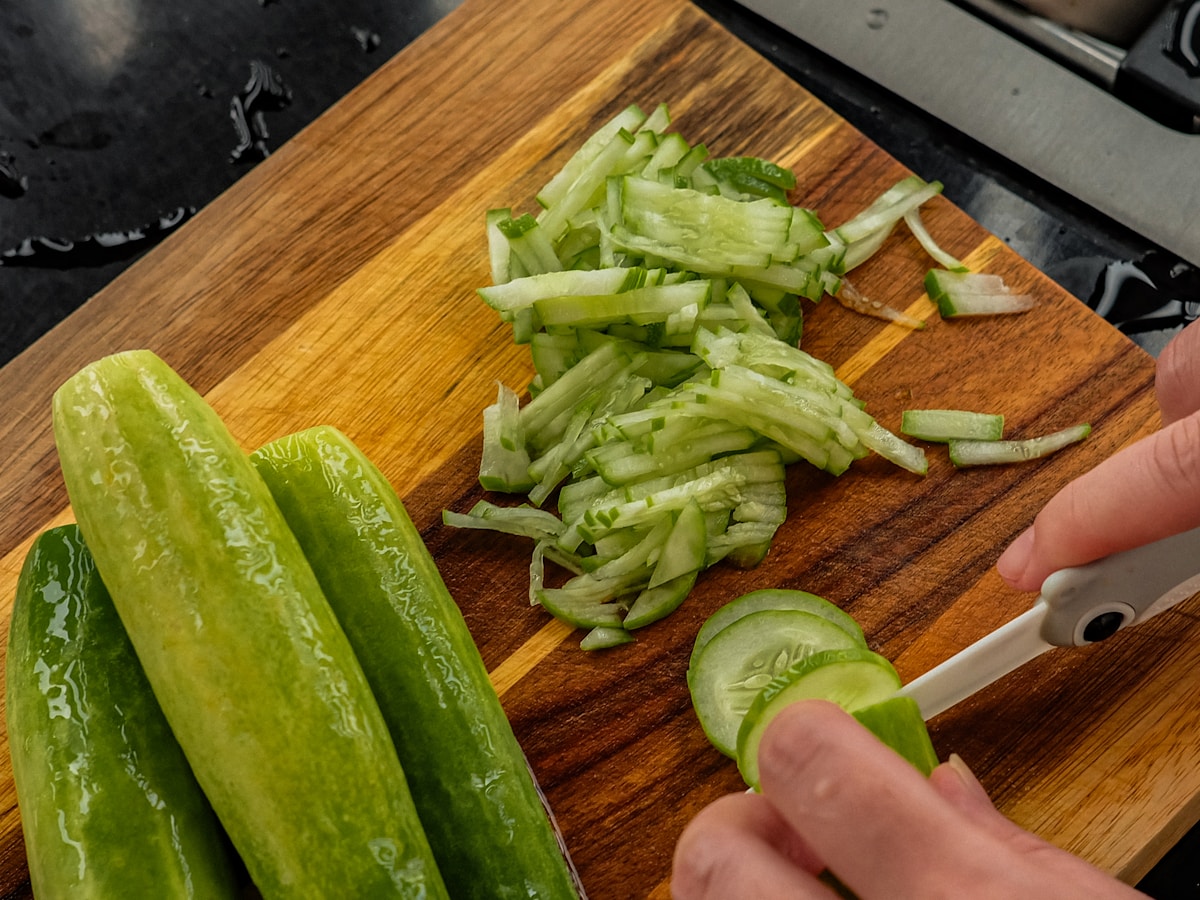
It might feel slow and clumsy initially, but this is the technique. It’s what allows professional chefs to work quickly without looking. Their guide hand is doing all the work of measuring and protecting. Practice this with something easy like a cucumber until the motion feels natural.
Your First Three Cuts to Master
Forget all the fancy French terms for now. If you can master these three basic cuts, you can tackle about 90% of recipes with total confidence.
-
The Consistent Dice: Uneven pieces of vegetable cook at different rates. Some turn to mush while others are still crunchy. The goal of a dice is to create uniform cubes. The secret to dicing a round object is to first make it square. Let’s use an onion:
- Cut the onion in half from pole to pole and peel it. Place it cut-side down on the board. Now it’s stable! (This is a kitchen hack in itself: always create a flat surface to work from.)
- Make thin, vertical slices, but don’t cut all the way through the root end. The root will hold it all together for you.
- Turn the onion and make a few horizontal slices, again not cutting through the root.
- Now, slice down across your previous cuts. Perfect little cubes will fall away from your knife. Uniformity unlocked!
-
The Smooth, Thin Slice: This is for things like mushrooms, zucchini, or celery. The key here is the rocking motion. Don’t lift the whole knife off the board.
- Hold your chef’s knife properly. Your guide hand is in the claw grip.
- Keep the tip of the knife down on the cutting board.
- To make a cut, press down and forward, lifting the heel of the knife up and down in a smooth, rocking motion. The tip rarely, if ever, leaves the board.
- This motion is efficient, fast (eventually!), and gives you incredible control over the thickness of your slices.
-
The Chiffonade (It’s Easier Than It Sounds): This is how you get those beautiful, thin ribbons of herbs like basil, mint, or spinach. It makes any dish look instantly more professional.
- Stack several leaves on top of one another. For basil, maybe 5-6 leaves.
- Tightly roll the stack of leaves into a little green cigar.
- Hold the cigar with your claw grip and use the rocking motion to slice it as thinly as you possibly can.
- When you’re done, gently fluff the slices with your fingers. Voilà! You have a perfect chiffonade.
Speed is the Enemy of Progress
When you’re learning, your goal is not speed. Your goal is safety and consistency. That’s it. Speed is a byproduct of muscle memory, and muscle memory only comes from thousands of repetitions done correctly. If you rush, you’ll build bad, unsafe habits. Or worse, you’ll cut yourself and become even more afraid of your knife.
Embrace the slowness. Put on some music. Focus on how the claw grip feels. Pay attention to the sound a sharp knife makes as it slices cleanly through a bell pepper. Cooking is a physical practice. The more you do it with intention, the more your hands will learn what to do without you having to think about it.
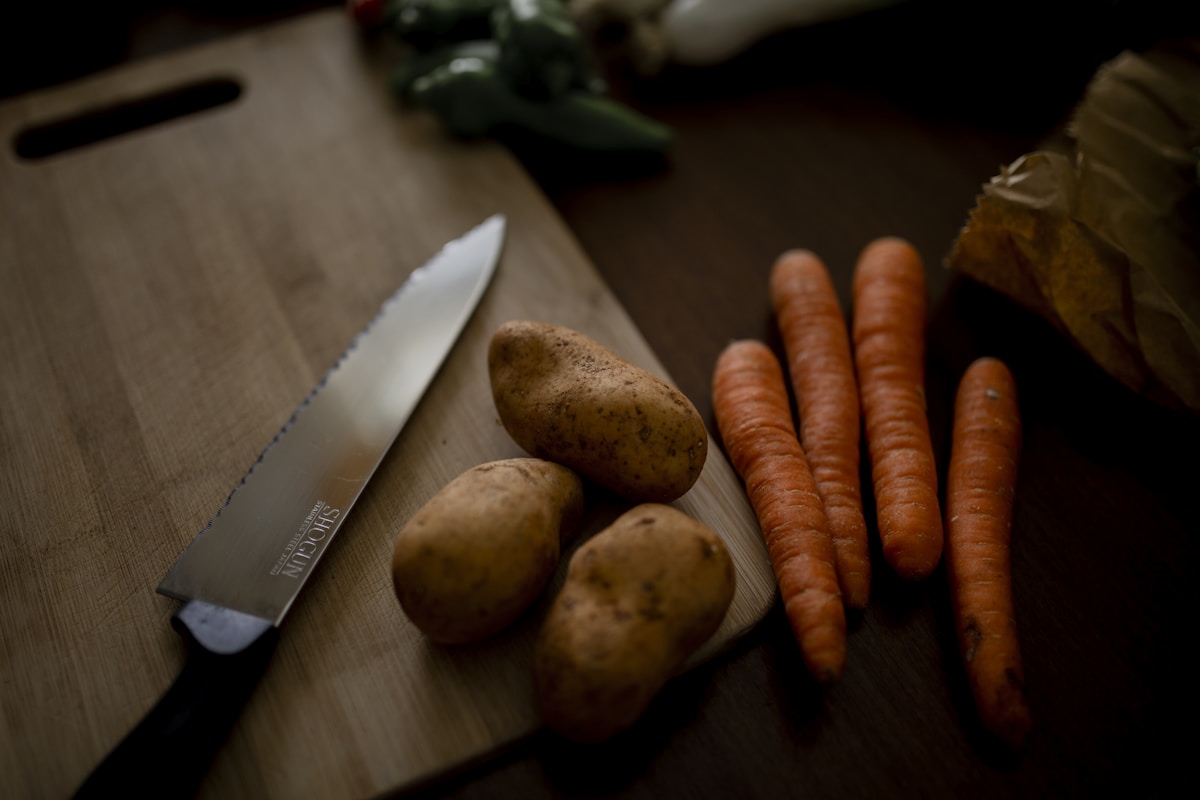
A great way to practice is to dedicate one afternoon to making a huge batch of vegetable soup. All that chopping—onions, carrots, celery, potatoes—is low-stakes practice. It doesn’t matter if the pieces are perfectly identical for a soup. It’s just you, your knife, and your cutting board, building confidence one vegetable at a time.
Try This Tonight
Feeling overwhelmed? Don’t be. Let’s make it incredibly simple. Your homework tonight isn’t to cook a whole meal. It’s much smaller.
Find one single onion or one potato. Place it on your cutting board. Your only mission is to practice the claw grip and turn that one vegetable into a reasonably even dice. Take ten or fifteen minutes if you need to. Don’t worry about the clock. Focus on how your knuckles guide the blade. Feel the control you have when you create a flat surface to work on.
That’s it. That’s the first step. You’re not just cutting a vegetable; you’re building a foundation of confidence that will serve you every single time you step into the kitchen. And trust me, it’s a wonderful feeling.