


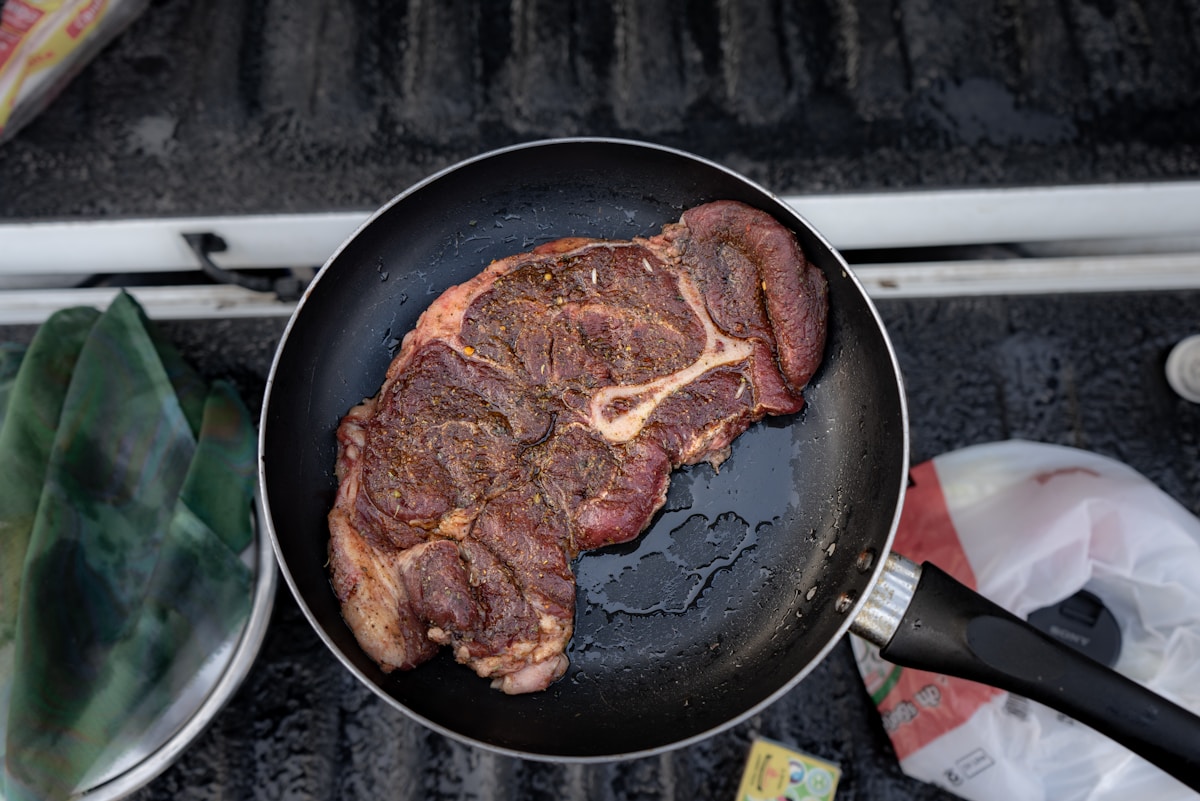
Let’s paint a picture. You’re at the grocery store, and you decide today is the day. You pick out a beautiful, thick-cut steak. It looks incredible. You get home, you’re excited. You heat up a pan, toss it in, and… things go wrong. Instead of that deep, crackly, dark brown crust you see in restaurants, you get a patchy, sad, grey piece of meat swimming in its own juices. It tastes… fine, I guess? But it’s not the steak you dreamed of.
If this sounds familiar, please know you are not alone. This is one of the most common kitchen hurdles, and it has absolutely nothing to do with you being a “bad cook.” It’s about technique, and the good news is that the technique is surprisingly simple once you understand the why behind the how. Cooking a brilliant steak isn’t about magic; it’s about getting a few key details right.
So, let’s banish the grey steak forever. Together, we’re going to walk through the steps to get a perfect, pan-seared steak with a crust so good you’ll hear it crackle. Everyone starts somewhere, and your journey to amazing steak starts right now.
Step 1: Your Steak Needs a Spa Day (Prep is Everything)
You could have the best pan and the most expensive steak in the world, but if you skip the prep, you’re setting yourself up for disappointment. What you do before the steak ever touches the heat is arguably the most critical part of the entire process.
First, let’s talk about moisture. Moisture is the mortal enemy of a good sear. When a wet steak hits a hot pan, the heat’s first job is to boil off all that surface water. This creates steam, and steaming is the opposite of searing. Think about it: you can’t toast wet bread, right? Same principle.
Take your steak out of the packaging and pat it completely, utterly, bone-dry with paper towels. I mean it. Pat the top, the bottom, the sides. When you think it’s dry, grab a fresh paper towel and pat it again. (Your future self will thank you.)
Next, seasoning. Be generous! You need more salt than you think. A lot of it will fall off in the pan or simply form the crust. Use coarse salt (like kosher salt or sea salt) and freshly cracked black pepper. Season all sides, including the fatty edges. Don’t be shy.
Finally, let it rest… at room temperature. Take your dry, seasoned steak and leave it on a counter for at least 30 minutes, and up to an hour. A freezing cold steak hitting a hot pan will cook unevenly. The outside will burn before the inside even starts to warm up. Letting it come to room temp ensures a much more even cook from edge to center.
Step 2: Choose Your Weapon (The Right Pan Matters)
I’m going to say something controversial: please, put away your non-stick skillet. I know you love it for eggs, but it’s not the right tool for this job. Non-stick coatings are not designed for the screaming-high heat required for a proper sear. At best, they won’t get hot enough. At worst, the high heat can damage the coating.
What you need is a pan that gets incredibly hot and, more importantly, stays incredibly hot. Your two best friends here are cast iron and heavy-bottomed stainless steel.
A classic cast-iron skillet, like the ones from Lodge (which are wonderfully affordable and will outlive us all), is the gold standard. Cast iron is a beast at retaining heat. Once it’s hot, it holds that temperature with incredible stability, delivering a consistent, powerful sear across the entire surface of the steak.
A heavy-bottomed stainless steel pan is also a fantastic choice. It heats up quickly and gives you a great, even crust. The key word here is “heavy-bottomed.” A thin, flimsy pan will have hot spots and won’t hold its heat when the cooler steak is placed in it.
Whichever you choose, the principle is the same: you need a material that can handle and hold intense heat.
Step 3: Mastering the Sizzle (Heat, Oil, and That Perfect Flip)
This is where the action happens. Place your chosen pan over medium-high heat and let it get hot. I don’t mean warm. I mean HOT. How hot? You should be able to see faint wisps of smoke rising from the dry surface of the pan before you even add any oil. This can take a good 5-7 minutes. Be patient.
Once the pan is properly preheated, add a tablespoon or two of a high-smoke-point oil. This means an oil that can get very hot before it starts to smoke and burn. Good choices are canola, grapeseed, avocado, or even clarified butter. Regular olive oil has too low a smoke point and will burn, creating a bitter taste. Swirl the oil to coat the bottom of the pan. It should shimmer and move thinly, almost like water.
Now, gently lay your steak in the pan, laying it away from you to avoid any oil splattering on you. And listen. You are listening for a loud, aggressive sizzle. A confident, roaring SSSSHHHHHHH. If you hear a gentle fizzle or nothing at all, your pan is not hot enough. (Yes, it’s okay to take the steak out, let the pan get hotter, and try again! The kitchen is more forgiving than you think.)
Do not touch it. Don’t poke it, don’t press it, don’t move it. Let it sit there and form that beautiful crust. For a 1-inch thick steak, this will take about 3-4 minutes per side for a nice medium-rare.
Step 4: The Only Way to Guarantee Perfection is a Thermometer
I can give you time estimates all day, but they are just that: estimates. Every stove is different. Every steak has a different thickness and fat content. Cooking by time is like driving with your eyes closed and hoping for the best. The only way to know for sure when your steak is perfectly cooked is to take its temperature.
An instant-read digital thermometer is the single best tool you can buy to level up your cooking confidence. Brands like ThermoWorks make incredible ones, but even an inexpensive model will change your life. You’re no longer guessing; you’re knowing.
Here’s a guide to internal temperatures. Remember to pull the steak off the heat about 5°F (3°C) before your target temperature, as it will continue to cook as it rests (this is called carryover cooking).
- Rare: Pull at 120°F (49°C) for a final temp of 125°F (52°C)
- Medium-Rare: Pull at 130°F (54°C) for a final temp of 135°F (57°C) (This is the sweet spot for many!)
- Medium: Pull at 140°F (60°C) for a final temp of 145°F (63°C)
- Medium-Well: Pull at 145°F (63°C) for a final temp of 150°F (66°C)
- Well-Done: Pull at 155°F (68°C) for a final temp of 160°F+ (71°C+)
Insert the thermometer into the thickest part of the steak, avoiding any bone. This simple step removes all the anxiety and guarantees perfect results every single time.
Step 5: The Restaurant Trick (Butter Makes Everything Better)
Ever wonder why restaurant steaks taste so incredibly rich and decadent? The secret is usually butter. After you flip your steak for the first time, add a few tablespoons of unsalted butter to the pan. Toss in a smashed clove of garlic and a hearty sprig of fresh rosemary or thyme.
As the butter melts and foams, carefully tilt the pan towards you so the butter pools at the bottom. Use a large spoon to continuously scoop up that fragrant, bubbling butter and pour it over the top of the steak. Do this for about a minute. This is called basting. It not only adds a tremendous layer of flavor but also helps to cook the steak gently and evenly.
Step 6: The Hardest, Most Important Step of All
You’ve done it. The crust is perfect, the temperature is spot-on. You pull the steak from the pan and your immediate instinct is to slice right into it. DON’T. This is the final, crucial test of your patience.
You must let the steak rest. Transfer it to a cutting board or plate and let it sit, untouched, for 5-10 minutes. A good rule of thumb is to let it rest for half of its total cooking time.
Here’s why: when you cook meat, the muscle fibers tighten up and push all the juices toward the center. If you cut into it immediately, all those delicious juices will spill out onto your cutting board, leaving you with a dry steak. Resting allows the fibers to relax and reabsorb those juices, ensuring every single bite is succulent and flavorful. Think of it as a runner catching their breath after a sprint. You have to give it a minute to calm down.
Your Turn: Try This Tonight!
Feeling ready? Let’s make this simple. Forget about perfection. We’re just aiming for a delicious experience.
Tonight, buy one good-quality steak, like a New York strip or a ribeye, about 1-inch thick. You don’t need to cook for an army. Just make one for yourself. Follow the steps above, but focus on just three things: patting it completely dry, getting your pan incredibly hot, and letting it rest for at least five minutes before you slice it.
That’s it. Don’t worry about the butter basting or getting the temperature to the exact degree. Just focus on those core principles. I promise, you’ll be amazed at the difference it makes. You can do this. The kitchen is a place for happy experiments, and this is one of the most rewarding ones there is.

