Oh, the moment of dread. You’ve spent hours, maybe even days, planning and baking the perfect birthday cake. It’s a towering, multi-layered masterpiece, just like your little one requested. You’ve swirled the frosting, placed the decorations, and you stand back to admire your work. And then you see it. A slight… tilt. A little bulge of frosting squeezing out from the middle. You tell yourself it’s nothing, but an hour later, your glorious creation is doing the Leaning Tower of Pisa, and you’re having visions of it toppling over right before everyone sings “Happy Birthday”.
If this sounds painfully familiar, please know you are not alone. This is one of the most common heartbreaks for home bakers, and it has almost nothing to do with your decorating skills. The problem started way back when you chose your recipe. The secret to a tall, stable, and stunning layer cake isn’t in the frosting; it’s in the foundation.
The Kitchen’s Biggest Secret: Cake Is Architecture
I want you to stop thinking like a baker for a moment and start thinking like an engineer. Imagine you’re building a skyscraper. Would you build the first few floors with light, airy foam blocks? Of course not! You’d use solid steel and dense concrete to support the weight of everything that’s going to be stacked on top.
A tiered cake works on the exact same principle. A two- or three-tier cake is heavy. Really heavy. You have the weight of the upper cake layers themselves, plus pounds of dense buttercream or fondant. All of that weight is pushing down, directly onto that bottom tier. If that bottom cake isn’t strong enough to handle the pressure, it will physically compress, bulge, and lean. It’s pure physics.
We often get so caught up in making our cakes taste light and fluffy that we forget their other job: to be structurally sound. For a simple sheet cake or a single-layer round, light and fluffy is wonderful! But when you start stacking, “sturdy” becomes the most important word in your vocabulary.
Why Your Favorite Light Cake Is The Wrong Tool for the Job
So, which cakes are the “foam blocks” of the baking world? Usually, they’re the ones we love the most for everyday eating.
- Boxed Cake Mixes: I know, I know. They’re convenient and consistent. But most standard boxed mixes are formulated with oil and extra leaveners to create a very open, airy, and tender crumb. This is fantastic for a 9x13-inch birthday party cake, but for stacking? It’s a recipe for disaster. The delicate structure simply can’t bear a load.
- Chiffon and Angel Food Cakes: These are the definition of light and airy. They get their incredible volume from whipped egg whites. Their cloud-like texture is their entire charm! But that texture is full of large air pockets held together by a very delicate protein structure. Trying to stack anything on top of an angel food cake is like trying to build a house on a literal cloud. It will collapse almost instantly.
Using one of these cakes as your base for a tiered creation is setting yourself up for failure. The pressure will squeeze the air out of the delicate crumb, causing the sides to bulge outward and the entire structure to tilt. No amount of frosting or prayers can fix a weak foundation.
Meet Your Stacking Superstars: Dense Cakes to the Rescue
Okay, so what should you use? You need a cake with a tight, fine crumb and a sturdy structure, which usually comes from a recipe that is butter-based rather than oil-based. Butter is solid at room temperature, which gives the finished cake a much denser, more stable structure than liquid oil.
Here are your go-to architectural heroes:
-
Classic Pound Cake: The name says it all! Traditionally made with a pound of butter, a pound of sugar, a pound of eggs, and a pound of flour, this cake is the definition of dense and delicious. Its crumb is tight, velvety, and incredibly sturdy. It’s a classic for a reason and can easily hold up multiple tiers without breaking a sweat. (Bonus: It tastes amazing with just about any fruit filling or buttercream.)
-
Chocolate Mud Cake: This is the heavyweight champion of the cake world. An Australian favorite, it’s rich, dark, and almost fudgy in consistency. Made with melted chocolate and butter, it has a very dense, moist crumb that is perfect for carving and stacking. If you’re building a sculpted cake or a very tall, heavy structure, a chocolate mud cake is your most reliable friend.
-
A Sturdy Victoria Sponge: Be careful here! An American-style “sponge” cake is often very light. A traditional British Victoria Sponge, however, is a butter-based cake with a much sturdier build. It uses the creaming method (beating butter and sugar together until light and fluffy) to create a cake that is tender but has a fine, tight crumb capable of supporting a tier or two. It’s a great option when you want something a little lighter than a pound cake but still strong enough for the job.
These cakes are your structural concrete. They have the integrity to not only support the weight above them but also to hold onto the wooden dowels and supports you’ll need for taller cakes.
The Pro Tip That Changes Everything: The Power of a Cold Cake
Now for the secret weapon used by every single professional baker: the refrigerator. You should never try to level, stack, and frost a room-temperature cake, especially not a big one.
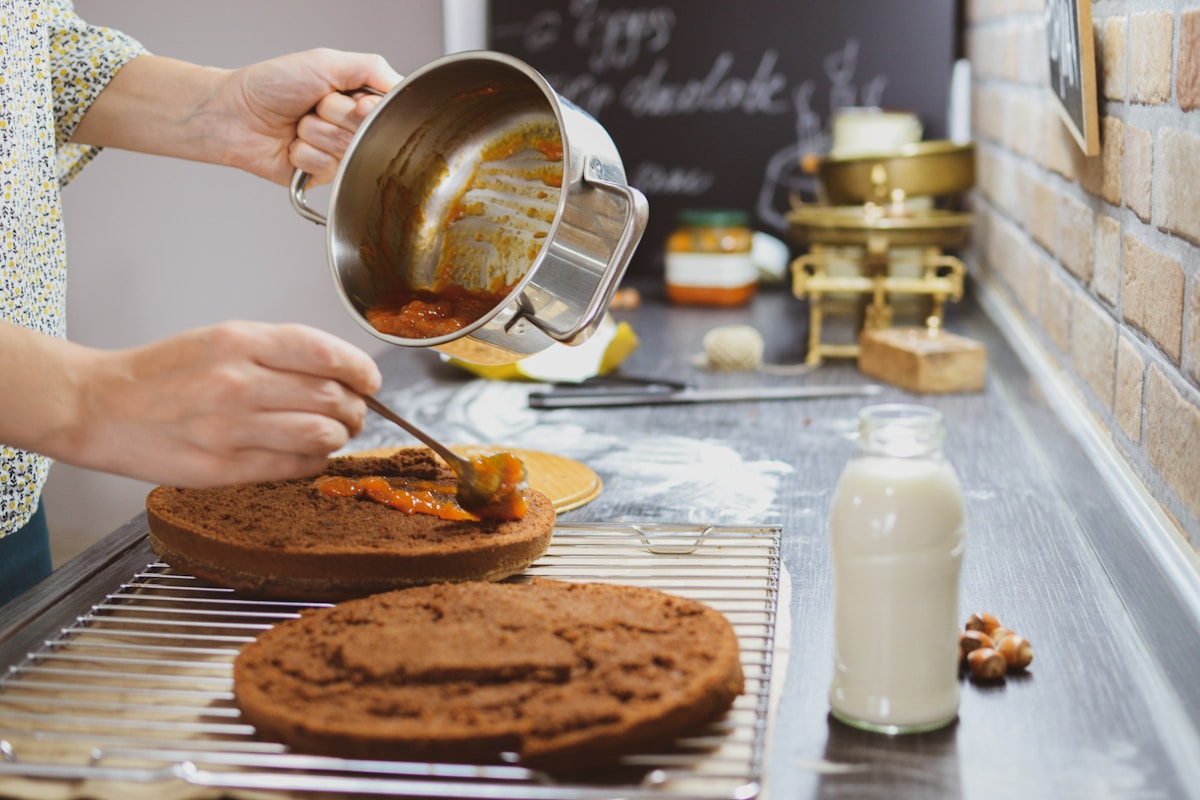
Once your sturdy cake layers are baked and have cooled completely on a wire rack, it’s time for a cold nap. Wrap each layer tightly in two layers of plastic wrap. This is important to lock in moisture and prevent it from drying out or picking up any weird fridge smells. Then, place them in the refrigerator overnight, or for at least 4-6 hours.
What does this do? It’s magic.
- It firms everything up: The butter in the cake gets cold and solid, turning your already-sturdy cake into a firm, solid disc.
- It minimizes crumbs: A cold cake is far less crumbly. When you level the top with a long, serrated knife, you’ll get a clean, sharp cut instead of a pile of messy crumbs.
- It makes frosting a dream: Trying to frost a soft, crumbly cake is frustrating. The frosting pulls up crumbs, making a muddy mess. A firm, cold cake provides the perfect canvas. Your crumb coat (that essential first, thin layer of frosting) will go on smoothly, trapping any stray crumbs before you apply your beautiful final coat.
(Trust me on this one. Chilling your layers is a non-negotiable step that will save you a world of frustration.)
A Quick Word on Dowels and Cake Boards
Now, even with the strongest cake, if you’re going higher than two layers (or have one very tall tier), you still need internal supports. This is where dowels and cardboard cake rounds come in.
The system is simple: each tier of your cake sits on its own cardboard round cut to the exact size of the cake. Then, you insert supports—like wooden dowels or even thick, sturdy bubble tea straws—into the tier below. These supports are cut to the exact height of the lower cake tier. The cardboard round of the cake above then rests directly on the dowels, not on the cake itself.
This transfers the weight of the upper tier down through the dowels to the cake plate below. But remember our engineering lesson: these supports are only effective if they’re inserted into a dense cake that can hold them firmly in place. If you stick a dowel into a fluffy boxed mix, the cake will just tear and shred around it under pressure. Strong cake + internal supports = a recipe for success.
Try This Tonight: Bake a Foundation, Not a Skyscraper
The next time a big birthday is on the horizon, don’t feel pressured to build a five-tier monster on your first try. The key to confidence is understanding your materials.
So, here’s your homework. This week, don’t worry about tiers or frosting or decorating. Just bake one of the sturdy cakes we talked about. Try a classic pound cake recipe in a loaf pan. Notice the weight of the batter. Once it’s baked and cooled, cut a slice and look at the crumb. See how tight and fine it is? Compare that texture to your memory of a light, airy boxed mix.
Feeling the difference is the first step. Once you understand what a “structural” cake feels like, you’ll be ready to build your next birthday masterpiece with confidence, knowing it will stand tall and proud until the very last candle is blown out.