


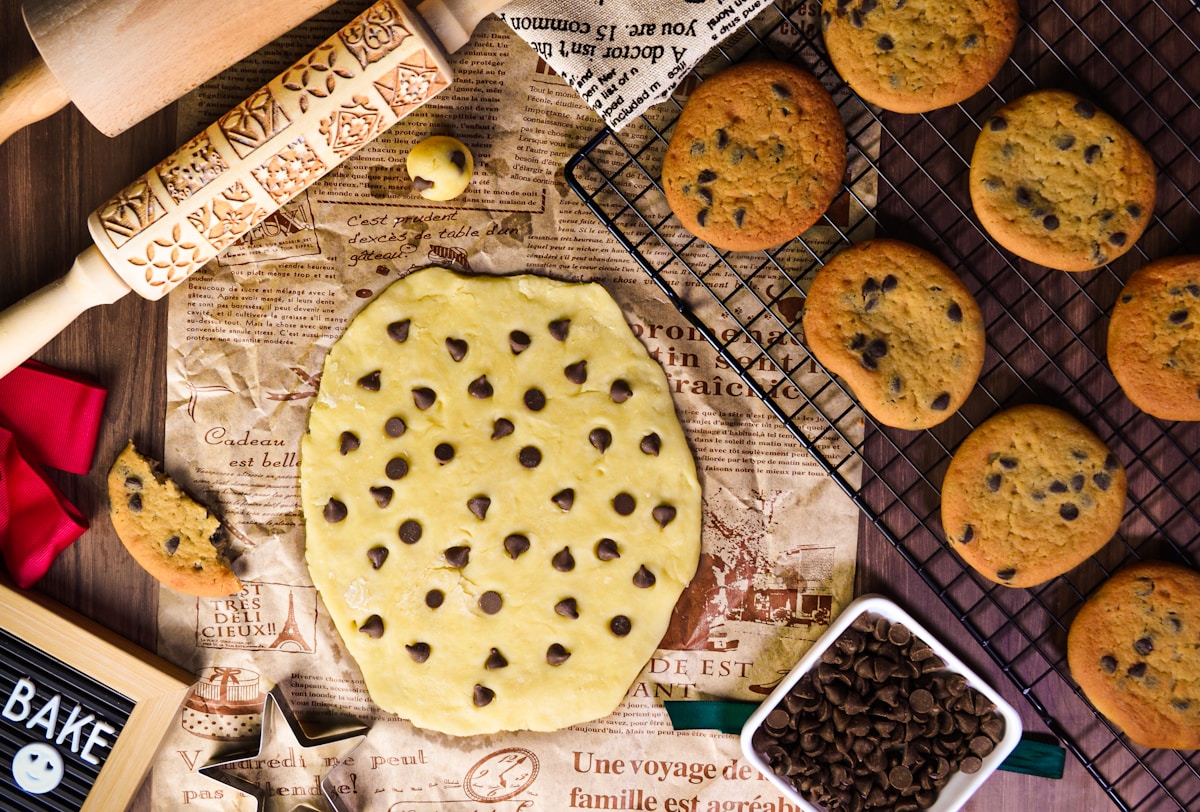
There are few baking projects as satisfying as slicing into a log of checkerboard cookie dough. You’ve carefully crafted the vanilla and chocolate layers, assembling them into a perfect mosaic. You slice, you bake, and you wait with anticipation. But when the timer dings, you pull out a tray of… blobs. The sharp, distinct squares have melted into a blurry, disappointing mess.
If this sounds familiar, you’re not alone. This is one of the most common frustrations with slice-and-bake cookies. The good news is that the solution isn’t a secret ingredient; it’s a matter of chemistry and temperature control. Let’s break down the science of spread and how you can guarantee crisp, clean patterns on your next batch.
The Science of Spread: It’s All About the Butter
At its core, cookie dough is an emulsion of fat, sugar, flour, and liquid. The star player in this particular drama is the fat, which is almost always butter in checkerboard cookies for its flavor and texture.
Think of butter as a collection of tiny, solid fat globules suspended in water. When the dough is cold, these globules are firm and distinct. When you place a cold cookie into a hot oven (around 350°F / 177°C), two things happen almost simultaneously:
- The structure sets: The heat begins to cook the flour and eggs, creating a solid, stable structure.
- The butter melts: The fat globules melt, releasing their water content as steam. This steam creates tiny pockets in the dough, contributing to a tender, slightly crumbly texture.
When the dough is properly chilled, the structure sets before the butter has a chance to fully melt and pool outwards. This is what holds the cookie’s shape. However, if your dough is warm, the butter is already soft and melts almost instantly upon hitting the oven’s heat. It flows outwards, dragging the rest of the ingredients with it before the flour and eggs can form a retaining wall. The result is a thin, spread-out cookie with a sad, indistinct pattern.
The Critical Chill: Your Most Important Step
Now that you understand the ‘why’, the ‘how’ becomes clear. Chilling isn’t an optional step; it’s the most crucial part of the entire process. Your goal is to get the butter in your dough log as cold and solid as possible before it sees the heat of the oven.
- Refrigerator Method: Once your checkerboard log is fully assembled, wrap it tightly in parchment paper or plastic wrap. Chill it in the refrigerator for a minimum of two hours. I often chill mine for four hours, or even overnight, for the best results. (Patience is a baker’s secret ingredient.)
- Freezer Method: If you’re short on time, you can fast-track the process. Place the wrapped log in the freezer for 30-45 minutes. Be careful not to freeze it solid, as it will be nearly impossible to slice.
Here’s a pro-tip from the bakers at King Arthur Baking: To maintain perfectly square edges, wrap your log in parchment paper. As it chills, the soft dough can settle and round out on the bottom. To prevent this, give the log a quarter turn every 30 minutes or so during the first part of chilling. This helps it firm up evenly on all four sides, preserving that sharp, geometric look.
Perfect Slices for Flawless Patterns
Chilling is only half the battle. Your slicing technique can make or break your final cookie. A dull or thick knife will compress and drag the dough instead of cutting it cleanly. This squishes the beautiful layers together, smearing the colors even before the cookie hits the oven.
Follow these steps for a perfect slice:
- Choose the right tool: Use a very sharp, thin-bladed knife. A chef’s knife or a thin slicing knife works wonderfully. Avoid serrated knives at all costs.
- Use firm pressure: Don’t saw back and forth. Position the blade and press down firmly and evenly in one smooth motion.
- Slice consistently: Aim for slices that are about 1/4-inch (about 6mm) thick. Slicing too thin can make the cookies fragile and prone to over-baking, while slicing too thick can increase spread.
- Clean your blade: After every few cuts, wipe the knife clean. This prevents chocolate dough from smearing onto the vanilla sections.
Once sliced, you can place the cookies directly onto a parchment-lined baking sheet. For extra insurance against spreading, you can even pop the entire tray of sliced cookies back into the refrigerator for 15 minutes while your oven preheats. (This is my go-to kitchen hack for perfect holiday cookies.)
A Simple Checkerboard Recipe to Master the Technique
Ready to put this knowledge to the test? Here is a reliable base recipe. Pay close attention to the chilling steps!
Ingredients:
- 1 cup (227g) unsalted butter, softened but still cool
- 1 cup (200g) granulated sugar
- 1 large egg, at room temperature
- 1 teaspoon vanilla extract
- 2 1/2 cups (300g) all-purpose flour
- 1/2 teaspoon salt
- 1/4 cup (21g) unsweetened Dutch-process cocoa powder
Instructions:
- In the bowl of a stand mixer (or with a hand mixer), cream the butter and sugar together until light and fluffy, about 3 minutes.
- Beat in the egg and vanilla extract until just combined.
- In a separate bowl, whisk together the flour and salt. Gradually add the dry ingredients to the wet ingredients, mixing on low speed until a soft dough forms.
- Divide the dough in half (a kitchen scale is your best friend here). Return one half to the mixer and blend in the cocoa powder until fully incorporated.
- Form each half of the dough into a rough square, wrap in plastic, and chill for 30 minutes to make it easier to handle.
- Roll each dough portion between two sheets of parchment paper into a rectangle of the same size, about 1/2-inch thick. Stack them, slice them, and assemble your checkerboard pattern.
- Wrap the final log tightly in parchment paper. Chill in the refrigerator for at least 2 hours, or in the freezer for 30-45 minutes.
- Preheat your oven to 350°F (177°C). Line baking sheets with parchment paper.
- Using a sharp, thin knife, slice the cold log into 1/4-inch rounds.
- Place the cookies about 1.5 inches apart on the prepared baking sheets.
- Bake for 10-12 minutes, or until the edges are lightly golden. Let them cool on the baking sheet for 5 minutes before transferring to a wire rack to cool completely.
By understanding the simple science of cold butter and hot air, and by practicing a little patience, you can transform your baking from frustrating guesswork to delicious, beautiful success. Happy baking!


