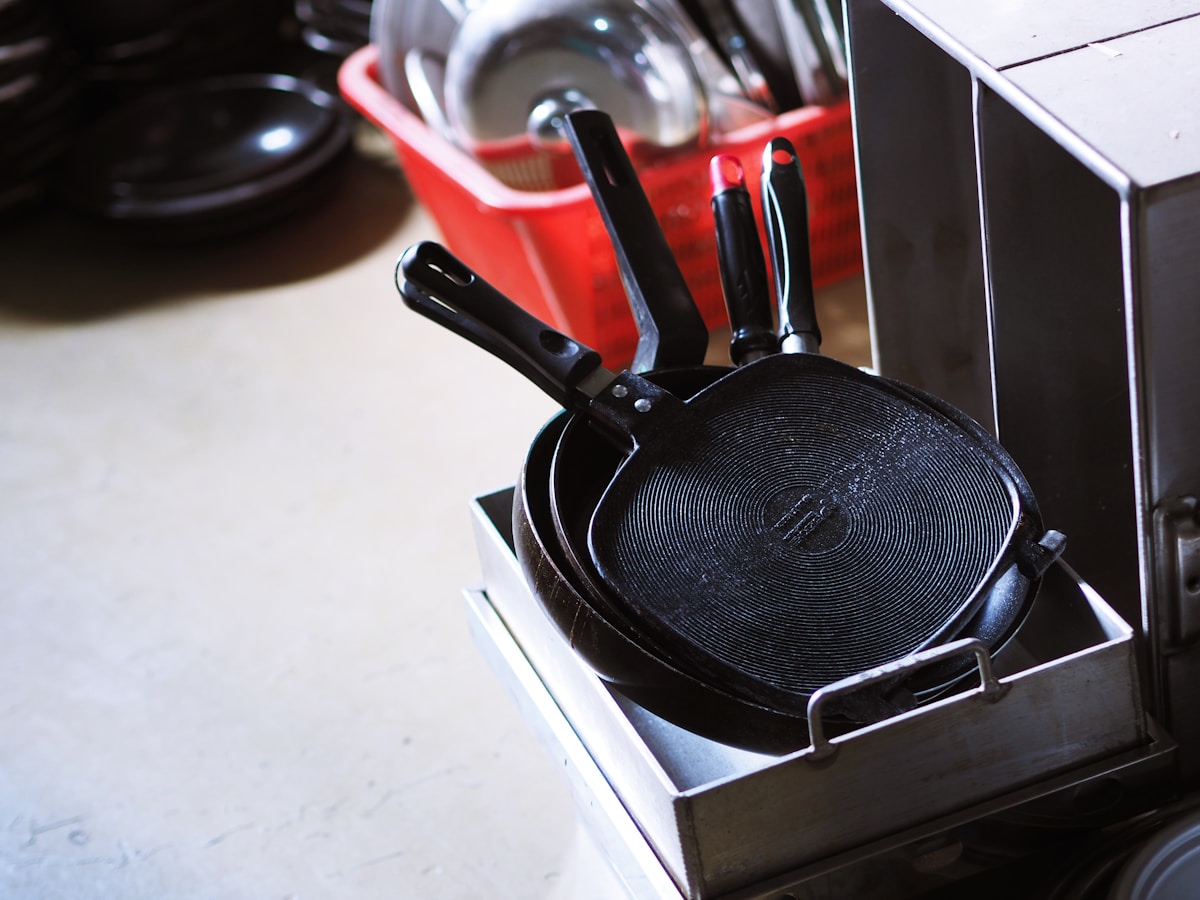
You’ve done it. You walked into a restaurant supply store, the culinary equivalent of a hardware store for grown-ups. The shelves are stacked high with no-nonsense, heavy-duty gear that promises performance without the fancy packaging. You spot a stack of skillets. They’re labeled ‘iron,’ they’re heavy like cast iron, but they look… different.
Instead of the familiar pebbly, black surface of a Lodge skillet, this one is smoother, almost grayish, with a brushed or machined look. It feels raw, industrial. You pick it up. The price is right, but a question hangs in the air: what is this thing, and how on earth do I take care of it?
Don’t put it back just yet. You might be holding one of the best pans you’ll ever own, but you need to know what you’re dealing with. These pans are built for a completely different world.
It’s Not Your Grandma’s Skillet
The pans you find in professional supply stores, especially in Europe, are designed for the brutal reality of a commercial kitchen. We’re talking about going from a screaming hot burner to a blast of water in a sink, getting scrubbed with metal scouring pads, and being used for hundreds of services a week. There’s no time for the gentle seasoning rituals we home cooks often enjoy.
To meet these demands, manufacturers use different materials and finishes that can be confusing at first glance:
- Durability is King: These pans are made to withstand thermal shock and physical abuse. Aesthetics are a distant second to performance.
- Industrial Dishwashers: Many are designed to survive the high heat and harsh detergents of commercial dishwashers, something that would strip a traditional home-seasoned pan bare.
- Rapid Heating: Time is money in a restaurant. These pans are engineered to get hot fast and hold that heat evenly across the surface.
Because of these needs, what looks like ‘cast iron’ might be a specific iron alloy, a different metal entirely, or cast iron treated with a specialized coating you won’t find at your local department store.
Decoding the Pan in Your Hands
So, what are you actually holding? It usually falls into one of three categories. The key is to look for a label or any stamped markings on the handle or bottom of the pan. That’s your first clue.
-
Machined Cast Iron: This is true cast iron, but instead of being left with a sand-cast texture, the cooking surface has been milled or machined to be perfectly smooth. This is a premium feature that high-end brands like Stargazer and Field Company offer in the US. The restaurant supply version is the same concept but without the fancy branding. It still needs to be seasoned just like any other cast iron pan, but it will form a slicker, more uniform surface.
-
Carbon Steel: This is the most common case of mistaken identity. Carbon steel pans (like those from De Buyer or Matfer Bourgeat) are the workhorses of most professional kitchens. They are lighter than cast iron, heat up faster, and are made of a stamped sheet of iron-carbon alloy. They often have a grayish or bluish metallic sheen when new and absolutely require seasoning. They develop a beautifully ugly, blotchy patina that is incredibly non-stick.
-
Industrial Coated Iron: This is the most likely culprit for the truly ‘weird’ finishes. To stand up to abuse, some manufacturers use specialized coatings. This isn’t your typical Teflon. Think of it as a super-durable, baked-on finish that is somewhere between enamel and a commercial non-stick layer. It’s designed to be ready to use out of the box and resistant to scratching and stripping. Trying to ‘season’ this type of pan is pointless and may even damage the coating.
The Label Is Your Best Friend (And a Water Test Is Your Backup)
Before you do anything, investigate. Your number one goal is to figure out if the surface is raw and needs seasoning, or if it’s a sealed, permanent finish.
Step 1: Read the Label. I can’t say this enough. Look for any sticker, etching, or insert that came with the pan. Words like ‘pre-seasoned,’ ‘requires seasoning,’ ’enamel,’ or material descriptions like ‘carbon steel’ are your roadmap. Don’t throw it away!
Step 2: The Magnet Test. A simple trick. If a magnet sticks firmly, you know you’re dealing with an iron-based (ferrous) pan, like cast iron or carbon steel. This helps rule out aluminum or stainless steel.
Kitchen Hack: The Water-Boil Test. If there’s no label and you’re still stumped, this is my go-to test. Wash the new pan with a little soap and water and dry it thoroughly. Put it on the stove over medium heat and pour in about a half-cup of water. As it comes to a boil, watch the surface closely.
- If the surface seems to absorb the water slightly or if the water spreads out evenly, you likely have raw, unseasoned metal. It needs seasoning.
- If the water beads up aggressively and dances around like a mercury ball, you likely have a pre-seasoned or coated surface. You’re probably good to go after a quick wash.
How to Care for Your Pro-Grade Pan
Once you’ve identified your pan, care is straightforward.
-
For Raw/Machined Cast Iron or Carbon Steel: You need to build the seasoning. Start by washing and drying it completely. Apply a micro-thin layer of a neutral, high-smoke-point oil like grapeseed, canola, or Crisco. (Seriously, just a tiny bit.) Wipe it off until the pan looks dry. Place it upside down in an oven preheated to 450-500°F (230-260°C) for one hour. Let it cool completely in the oven. Repeat this 2-3 times for a great starting base.
-
For Coated/Industrial Finish Pans: Do not season it! Treat it like a very tough non-stick pan. You can usually use metal utensils on it (within reason) and wash it with soap and water. The main thing to avoid is extreme thermal shock—don’t take a searing hot pan and plunge it into a sink of cold water. Otherwise, it’s designed to be low-maintenance.
Embrace Function Over Form
The beauty of these restaurant supply pans isn’t in their perfect, glossy appearance. Their beauty is in their performance. They are unapologetic tools. They get hot, they cook food, and they last forever.
So next time you see one of those strange-looking brushed metal skillets, don’t be intimidated. Do a little detective work, understand what you’re buying, and you might just walk away with a professional-grade tool that will serve you well for years, all for a fraction of the price of a designer brand. (Your wallet will thank you.)