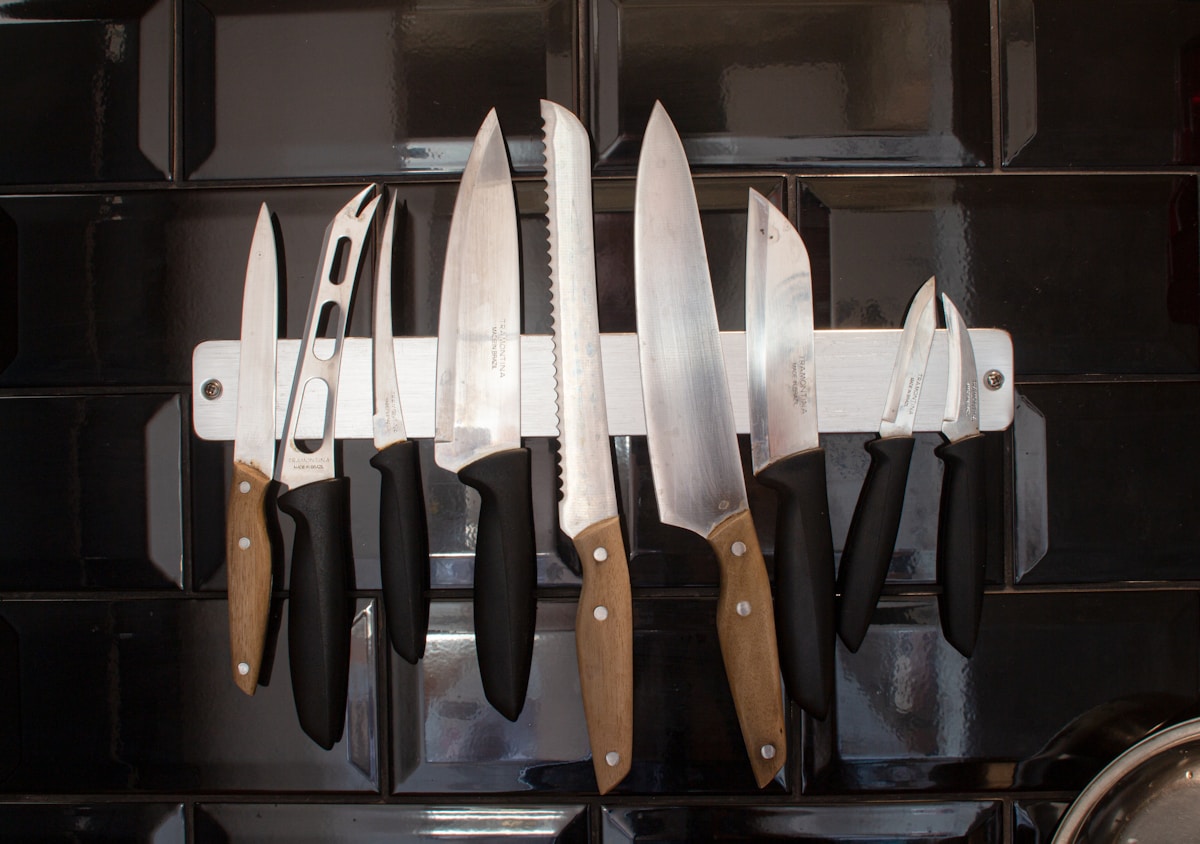
You drop a favorite Japanese knife, hear the sharp tap against the floor, and immediately see that the fine point is gone. It is an unsettling moment, especially when the knife is expensive or has become your most-used prep tool.
The short answer: you may be able to repair a chipped knife tip at home when only a tiny amount of metal is missing, the blade is straight, and you already have reliable sharpening control. A crack, bend, large break, or damage extending down the edge is a better case for a skilled knife repair service. Most tip repairs create a new point by removing metal; they do not restore the original point exactly.
Key Takeaways
- A small chip on a straight, crack-free blade can often be reshaped at home by an experienced whetstone user.
- A bent, twisted, cracked, or extensively chipped tip should be assessed professionally before any sharpening begins.
- Re-tipping permanently shortens and changes the blade profile, so preserving function matters more than recreating the exact factory outline.
- Coarse stones remove metal quickly; work slowly, inspect often, and stop if the repair grows beyond the damaged area.
- Protect a repaired tip with careful cutting, hand-washing, and storage that prevents contact with hard objects.
Assess the damage before trying to repair a chipped knife tip
Stop using the knife until you have inspected it. A damaged tip can remain very sharp, and a jagged break may catch during prep, cleaning, or storage. Carry the knife with the edge pointed away from you, and do not leave it loose on a counter or in the sink.
Gently clean and dry the blade so residue does not hide the damage. Inspect it in strong, even light. Whether you can repair a chipped knife tip yourself depends on the condition of the entire blade, not only the missing point.
Use this quick inspection checklist:
- Look directly at the tip. Is it a tiny missing point, a shallow chip, or a larger snapped-off section?
- View the knife from the spine and along the cutting edge. Look for a tip that leans sideways, twists, or sits out of line.
- Check for a visible line running from the damaged area into the blade. This may indicate a crack and warrants professional assessment.
- Carefully pass a soft cloth near the damaged area without forcing it across the edge. Snagging fibers can reveal a burr, rough edge, or chip beyond the obvious break.
- Look for chips continuing down the cutting edge. A damaged tip plus several edge chips is a much larger job than one missing point.
- Check the handle and blade junction. If anything feels loose or unstable, do not attempt a home repair.
A tiny missing point on a straight, otherwise sound blade is usually the most realistic DIY case. A shallow chip just behind the tip may also be manageable if you are comfortable sharpening on whetstones. The aim is to create a gradual, usable point while preserving as much blade as possible.
A bent tip is different. It can look minor, but trying to force it back may cause further damage depending on the blade’s construction and condition. A crack is more concerning because reshaping the outline does not address a possible structural issue. Set aside a knife with either problem and have it evaluated.
Thin Japanese kitchen knives deserve especially close inspection. Their fine geometry helps them cut cleanly, but a large correction can noticeably change their profile. Do not assume that a small-looking break requires only a few quick passes on a stone.
Understand what reshaping a knife tip changes
Broken knife tip repair is generally a reshaping job. You remove steel around the missing section until the spine, edge, and new point meet in a smooth, functional shape. This can return a knife to useful service, but the metal removal is permanent.
The most obvious change is length. A tiny chip may shorten the blade very little, while a larger break can affect reach and balance. On a short petty knife, losing a small amount of length may barely register. On a long slicer, changing the final section can affect how the blade enters food and feels during detail work.
The blade profile changes as well. Removing more material from the spine may preserve more of the cutting edge but leave the knife with a higher or more abrupt tip. Removing more from the edge can alter the belly, or curve, of the blade. That may affect rocking motions, push cuts, and how naturally the knife follows the board.
A good repair blends the new point into the knife’s existing lines rather than creating a hooked beak or sudden flat spot. The point should sit sensibly in relation to the edge and spine, giving you predictable control for small cuts. It does not need to match the exact factory outline to work well.
This is the main trade-off in Japanese knife chip repair: a conservative repair preserves blade life, while chasing a visually perfect silhouette can remove more steel than necessary. A functional point with a smooth, gradual profile is usually a better result than aggressive reshaping.
Before starting, study the blade profile from the side and decide what you are trying to preserve. If you cannot picture where the new point should land, that is a practical reason to stop and seek professional help. Poor geometry is not merely cosmetic; it can make the knife less comfortable and less predictable to use.
When a home whetstone knife repair is realistic
A home whetstone knife repair is most realistic when the missing area is small, the blade is straight and crack-free, and you have already sharpened knives successfully. Tip work is not an ideal first sharpening project because it requires attention to shape as well as edge sharpness.
Set up a stable work area before beginning. Useful basics include a coarse hand-powered abrasive suitable for repair work, a finer stone for edge refinement, water if directed by the stone maker, a non-slip stone base, a towel to control moisture, and good lighting. Keep the area clear so you are not reaching over clutter with a sharp blade.
Coarse abrasives remove material quickly, which is helpful when metal needs to come off. They are not automatically the safest answer for a major break. A coarse stone can make it easy to overshoot the shape, create uneven bevels, or remove more steel than planned when pressure and angle are inconsistent.
Work slowly and inspect frequently. The broad sequence is to establish a gradual new point, blend the altered section into the existing edge, then sharpen both sides consistently to restore a clean, continuous cutting edge. Once the shape is established, move to a finer stone to refine the edge and remove roughness.
Do not treat the damaged tip as a separate small section. The repair should transition into the blade over a reasonable distance rather than creating an abrupt notch behind the new point. Every few passes, hold the knife at eye level and check the silhouette from both sides.
Keep the knife controlled and supported on the abrasive. If it begins to feel awkward, if you cannot maintain consistent contact, or if the repair expands much farther down the blade than expected, stop. Continuing simply because you have already removed metal can turn a modest repair into an unnecessarily large one.
Freehand whetstones offer the most flexibility for reshaping knife tips, but they demand practice. They let you control where material comes off and blend the profile gradually. The trade-off is that your hands determine the consistency of the result.
Guided sharpening systems can help maintain a repeatable edge angle and may be useful for refining an edge after modest reshaping. Their clamps, rods, and fixed abrasive paths may not suit a major tip correction or an unusual blade profile. They are not a complete solution for every broken knife tip repair.
Powered grinders, belt machines, and rotary tools are poor first choices for a valued kitchen knife. They can remove steel very quickly, and control can disappear in a moment. Heat management and blade geometry vary by tool and technique, leaving a novice with little margin for error. Hand abrasives or professional service are usually the more cautious options.
Choose professional repair or replacement when the risk is high
Seek professional assessment if you find a crack, a bent or twisted tip, a large missing section, or chips extending well down the edge. Professional help also makes sense for laminated or otherwise complex blades, unusually thin grinds, sentimental knives, and any knife you would be upset to alter permanently.
Cost is not the only reason to use a service. A capable sharpener can assess the full blade profile, determine how much material must be removed, and explain how the reshaped tip may look and feel. That clarity matters when the knife has financial, practical, or personal value.
When comparing sharpening services, ask direct questions:
- Do you regularly repair and sharpen Japanese kitchen knives?
- How do you handle major tip reshaping: controlled hand work, low-heat equipment, or another method?
- Can you explain how the repair may change blade length and profile?
- Will you contact me before making a substantial shape change?
- How will the knife be packed or protected during return shipping, if shipping is involved?
A service does not need to promise an invisible repair. A realistic explanation of the compromises is often more useful than a guarantee that every knife will return to its exact original geometry.
If the knife is relatively new, review the maker’s warranty and service terms before altering it. Policies vary, and some makers may have specific service channels or care requirements. Verify details directly with the manufacturer rather than assuming outside repair will or will not affect coverage.
When should you replace a kitchen knife instead of repairing it? Replacement may be more practical when cracking, corrosion, repeated structural damage, a loose handle, or severe shortening makes useful restoration unrealistic. It can also make sense when the likely repair no longer fits the knife’s remaining usefulness or your budget. A damaged knife should earn its place through stable, predictable performance, not sentiment alone.
Protect the repaired tip and prevent another chip
Once repaired, treat the tip as a precise cutting feature rather than a lever. Use the knife on an appropriate cutting board, and avoid twisting, prying, or scraping hard surfaces with the edge. Thin Japanese knives are generally best reserved for produce, boneless proteins, and tasks within the maker’s intended use.
Avoid using a fine kitchen knife on bones, frozen foods, hard pits, or similarly resistant items unless the manufacturer specifically describes it as suitable. Choose a heavier knife or another tool for those tasks. This helps reduce the chance of new chips that sharpening cannot prevent.
Hand-wash the knife after use and dry it promptly. Do not leave it loose in a sink, where the edge and tip can strike cookware, cutlery, or the sink itself. Clean carefully around the repaired point without pressing a towel into the edge.
Store the knife where it cannot collide with other tools. A compatible knife block, securely installed magnetic holder, edge guard, or dedicated drawer insert can work well when used thoughtfully. The key is supporting the tip and edge so they do not knock against hard objects when the knife is stored or removed.
Use light, routine sharpening rather than waiting until the edge is badly worn. Inspect the knife promptly after a drop, too. Catching a tiny chip early can reduce the amount of metal needed for a later repair.
FAQ: Can a Chipped Japanese Knife Tip Be Repaired at Home?
Can I repair a chipped knife tip with a regular sharpening stone?
Possibly, if the damage is minor and the stone is stable and suitable for material removal. A coarse stone can help establish a new shape, followed by a finer stone to refine the edge. The important factors are chip size, blade condition, stone stability, and your ability to sharpen with control.
Will reshaping a knife tip ruin a Japanese knife?
Careful reshaping does not automatically ruin it. It can restore a useful point and make the knife pleasant to use again. However, it permanently changes the blade’s shape, length, and possibly its cutting feel, so a valuable or complex knife is often worth sending to a professional.
How do I know when to replace a kitchen knife instead of repairing it?
Consider replacement or professional assessment when there are cracks, serious warping, loose construction, repeated damage, extensive corrosion, or enough lost steel that the knife no longer has a useful shape. Compare the likely repair outcome with the knife’s condition and value. A repair is worthwhile when it leaves you with a stable, practical tool.