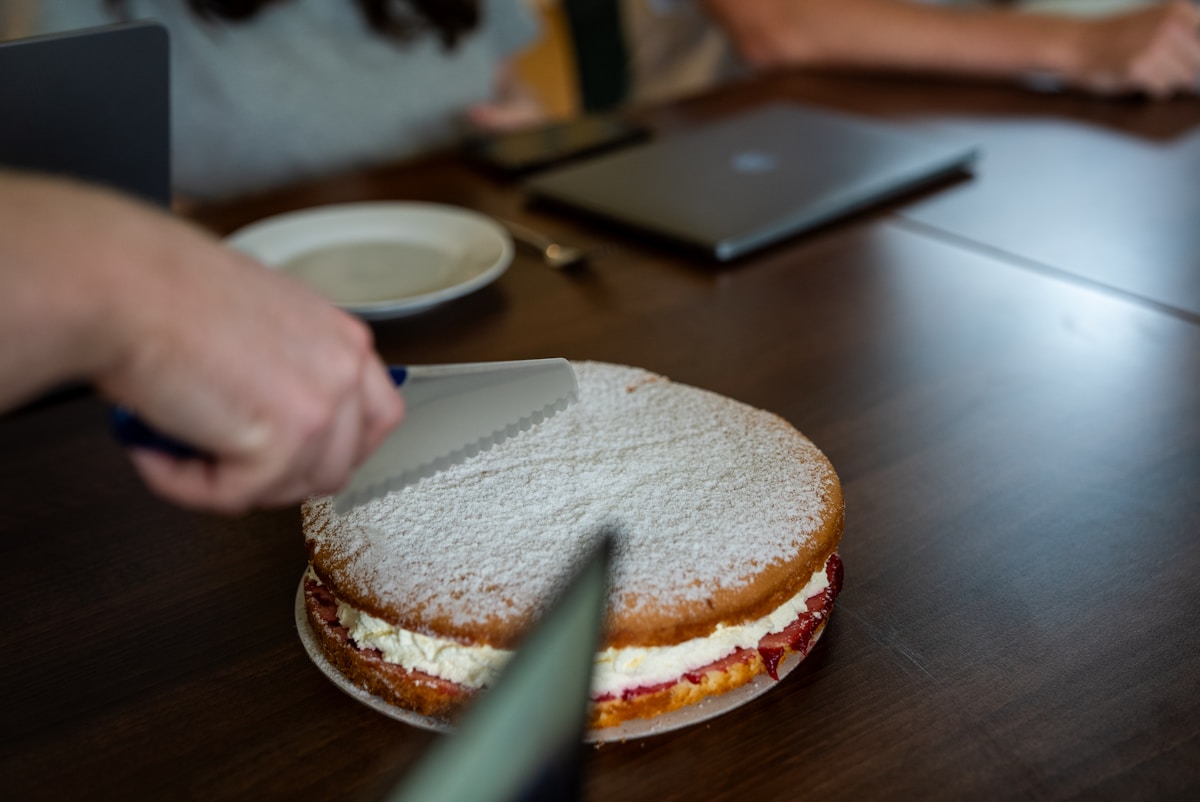
You’ve done everything right. Your cake layers are perfectly level, tender, and fragrant. The lemon curd is silky, the raspberry jam is vibrant. You carefully assemble your masterpiece, layer by layer, envisioning the beautiful cross-section and the clean, white frosting. Then, as you apply the final crumb coat, you see it: a faint purple or yellow streak, a tell-tale sign of a filling jailbreak. A few hours later, your pristine cake has unsightly bulges and weepy seams. It’s a moment that can deflate even the most optimistic baker.
This isn’t a failure of your recipe; it’s a failure of physics. But like any good science experiment, the problem has a logical, elegant solution. That solution is the buttercream dam, and mastering it is the single most important technique for elevating your layer cakes from homemade-looking to bakery-perfect.
The Physics of a Leaky Cake
Before we build the solution, let’s understand the problem. Think of your cake as a simple structure. You have solid, spongy layers (the cake) and a soft, often fluid filling (the jam, curd, or pastry cream). When you stack the cake, the weight of the upper layers exerts significant downward pressure on the layers below.
Imagine squeezing a water balloon. The water, being a fluid, will push outwards in every direction. Your soft cake filling behaves in exactly the same way. It gets squeezed by the weight above it, and it searches for the path of least resistance—which is always outwards, between the cake layers. This is why you see that dreaded bulge around the cake’s equator, which inevitably breaches your final coat of frosting.
This doesn’t just ruin the look; it compromises the cake’s structural integrity. The leaking filling acts as a lubricant, making the layers prone to sliding, especially during transport. The key to stopping this is not to use less filling, but to contain it properly.
The Solution The Mighty Buttercream Dam
A buttercream dam is exactly what it sounds like: a sturdy, circular wall of stiff frosting piped around the top perimeter of a cake layer. Its job is simple but critical: to act as a barrier, containing the soft filling and bearing the structural load of the layer above it. The jam can’t leak out because it’s held in place by a solid, fat-based wall.
This technique allows you to use wonderfully soft, flavorful fillings without fear. It’s the secret behind those professional cakes with perfectly clean, distinct layers of cake, dam, and filling. It’s a simple concept, but execution is everything. For that, we need to talk about chemistry—the chemistry of the perfect buttercream for construction.
How to Build a Flawless Dam A Step-by-Step Guide
Building a dam isn’t difficult, but it requires the right materials and a methodical approach. The most critical component is using a buttercream with the right consistency. The frosting you use for the dam must be stiffer than the frosting you use to fill and cover the cake.
Step 1: Formulate Your Structural Buttercream
Your standard, silky frosting is too soft for this job. You need a frosting with a higher ratio of powdered sugar to fat, which makes it less fluid and more structural. This simple ‘stiff consistency’ American buttercream is perfect for the task.
- Ingredients (for a 3-layer, 8-inch cake dam):
- 1/2 cup (113g) unsalted butter, softened but still cool
- 2 cups (240g) powdered sugar, sifted
- 1/2 teaspoon pure vanilla extract
- A tiny pinch of salt
- 1/2 to 1 teaspoon whole milk or heavy cream (use only if absolutely necessary)
Instructions: In the bowl of a stand mixer fitted with the paddle attachment (a KitchenAid is great for this), beat the cool, softened butter on medium speed for about 1-2 minutes until smooth and creamy. Scrape down the bowl. With the mixer on low, gradually add the sifted powdered sugar. Once it’s mostly incorporated, add the vanilla and salt. Increase the speed to medium-high and beat for 3-4 minutes until the buttercream is very thick and holds its shape. It should be noticeably stiffer than a typical frosting. If it seems almost un-spreadably thick, that’s perfect. Avoid adding liquid if you can; it weakens the structure.
The Science: The fat crystals in the butter form a matrix that traps the fine sugar particles. With less liquid (water/milk) and more sugar, this matrix becomes incredibly dense and rigid, especially when chilled. This is what gives the dam its strength.
Step 2: Prepare Your Tools
You’ll need a piping bag fitted with a large round tip. A Wilton 1A or Ateco 808 is ideal, as it pipes a thick, substantial rope of frosting. If you don’t have one, you can simply snip a 1/2-inch (1.3cm) opening from the end of a disposable piping bag.
Step 3: Pipe the Dam
Place your first (and completely cooled) cake layer on your cake board or turntable. Fill your prepared piping bag with the stiff buttercream.
Holding the piping bag perpendicular to the cake, apply steady pressure and pipe a continuous ring of buttercream about 1/4-inch (6mm) in from the outer edge of the layer. The piped ring should be about 1/2-inch (1.3cm) tall. The goal is a uniform wall with no gaps or weak spots.
Step 4: Add Your Filling
Now, spoon your jam, lemon curd, or other soft filling into the center of the dam. Use a small offset spatula to gently spread the filling in an even layer. Be careful not to spread the filling over the top of the buttercream wall. The level of the filling should be just slightly below the top of the dam. (This is a critical detail!)
The Chill The Most Important Step of All
You could stack the next layer right now, but you’d be missing the most crucial part of the process. You must chill the filled layer. This is non-negotiable.
Place the entire cake board with the filled layer into the refrigerator for at least 15-20 minutes, or into the freezer for 10 minutes. The goal is to get the dam cold and firm to the touch. The ideal temperature range is 35-40°F (2-4°C).
The Science: Chilling causes the butter in your frosting to solidify completely. The fat molecules crystallize and harden, transforming your soft-ish dam into a rigid, structural wall. A chilled dam will not squish, bulge, or slide when you add the weight of the next layer. Skipping this step is the number one reason why dams fail.
Once the dam is firm, retrieve it from the fridge. Gently place your next cake layer on top, making sure it’s perfectly centered. Press down lightly. Now, repeat the process: pipe a dam, add the filling, and chill. Continue for all your layers.
Troubleshooting Common Dam Disasters
Even with a plan, things can sometimes go sideways. Here’s how to diagnose and fix the most common issues.
-
Problem: My dam still bulged out.
- Likely Cause: Your buttercream wasn’t stiff enough. Either the ratio of sugar-to-fat was too low, or your kitchen was too warm, causing the butter to be overly soft.
- The Fix: Next time, add more powdered sugar to your dam frosting, a tablespoon at a time, until it’s very stiff. If your kitchen is warm (above 72°F / 22°C), make sure your butter is cool to the touch when you start, and work quickly.
-
Problem: The jam flowed over the top of the dam.
- Likely Cause: You overfilled it. It’s tempting to pack in as much delicious filling as possible, but this is a recipe for disaster.
- The Fix: Always keep the filling level slightly below the top edge of the dam. This leaves a buffer zone for when the next layer is added, preventing overflow.
-
Problem: My cake layers are sliding around!
- Likely Cause: You skipped or rushed the chilling step. A soft, room-temperature dam is slippery. A cold, hard dam provides grip and stability.
- The Fix: Never skip the chill. For very tall or heavy cakes (like a wedding cake), you can also insert a central wooden dowel through all the layers after stacking for ultimate insurance.
The Science of a Stable, Beautiful Slice
Baking, at its core, is chemistry you can eat. The buttercream dam is a perfect example of using the properties of ingredients to solve an engineering problem. You are using a stable, temperature-sensitive fat-and-sugar emulsion to contain a less stable, more fluid filling. By controlling temperature, you control the physical state of the dam, turning it from a soft paste into a solid wall right when you need it most.
Once you master this technique, a whole new world of cake fillings opens up. You can confidently fill your cakes with delicate mousses, silky curds, and luscious fruit compotes, knowing that your final creation will be as stable and beautiful on the inside as it is on the outside. (Your future self, pulling a perfect slice from the fridge, will thank you.)