Let’s be honest for a moment. You’re standing at your kitchen counter, a beautiful, fresh onion in one hand and a big, shiny chef’s knife in the other. Your goal is a neat, tidy dice for your soup. The reality? A wobbly, uneven pile of onion bits, some too big, some paper-thin, and a lingering fear that your fingertip might be the next thing on the chopping block. If this sounds familiar, take a deep breath. You are not alone.
Every single person who cooks with confidence today started out exactly where you are. The kitchen knife, especially a chef’s knife, can feel incredibly intimidating. It’s sharp, it’s big, and it feels like it has a mind of its own. But I’m here to tell you a little secret: that knife isn’t your enemy. In fact, it’s about to become your single best friend in the kitchen. Learning to use it correctly isn’t about being a fancy chef; it’s about unlocking a world of control, efficiency, and—most importantly—safety. Today, we’re going to demystify the knife. We’ll turn that fear into confidence, one slow, deliberate slice at a time.
The Two-Hand Tango Your Secret to Safe Slicing
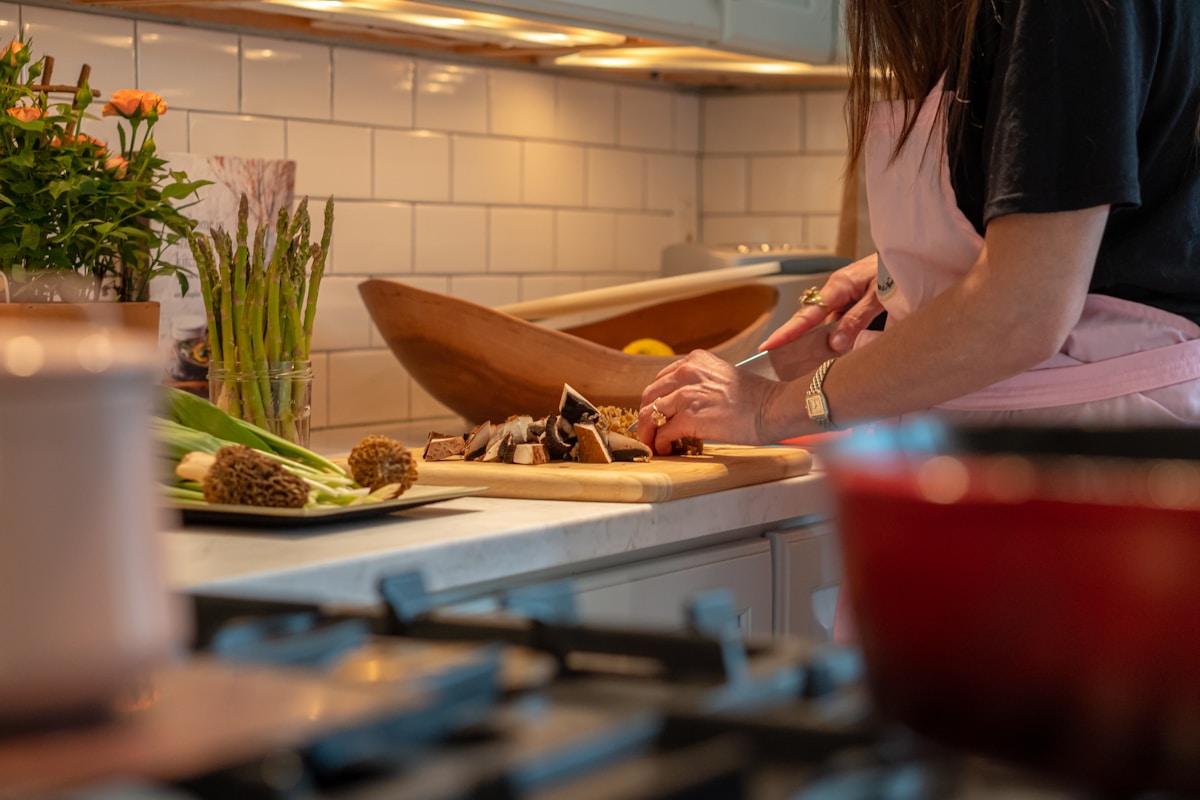
Before we even make a single cut, let’s talk about how you hold everything. This is the absolute foundation. Get this right, and everything else becomes ten times easier and a hundred times safer. It’s a two-part dance between your guide hand and your knife hand.
Your Guide Hand: The Claw
This is for the hand not holding the knife. Its job is to hold the food steady and guide the blade. The biggest mistake beginners make is holding food with their fingertips pointing out, directly in the path of the blade. We’re going to fix that right now with the “claw grip.”
Imagine you’re picking up a softball. Curl your fingers inward so that your fingertips are tucked safely away and your knuckles are pointing forward. Your thumb should be tucked behind your fingers, helping to grip the food. Now, place your hand on the vegetable. Your first and middle finger knuckles should be slightly ahead of the others. These knuckles will now act as a sturdy, flat wall for the side of the knife blade to rest against as you cut. The blade will slide up and down against your knuckles, which are impossible to cut, while your precious fingertips are tucked back, completely out of harm’s way. It will feel awkward at first. That’s okay! Practice just making the claw shape a few times without any food. It’s all about building new muscle memory.
Your Knife Hand: The Pinch Grip
Now for the hand holding the knife. Most people instinctively grip the handle like it’s a hammer, with all their fingers wrapped around it. This gives you power, but very little control. We want control.
The proper way to hold a chef’s knife is with a “pinch grip.” Hold the handle, but then slide your hand forward. Pinch the top of the blade itself, right where it meets the handle (this area is called the bolster), between your thumb and your forefinger. Then, wrap your remaining three fingers comfortably around the handle. This grip makes the knife feel like an extension of your hand. It gives you incredible control over the angle and motion of the blade. You’re no longer just pushing the knife down; you’re guiding it with precision.
Try it now. Pick up your knife with a pinch grip and rest the side of the blade against the knuckles of your claw hand. This is the position. This is your safe, stable starting point for every single cut.
From Wobble to Rock The Magic Motion of the Cut
Now that your hands are in position, let’s talk about the movement. Many beginners try to chop food by pushing the knife straight down in a forceful, vertical motion. This takes a lot of effort, can crush delicate food, and makes the knife more likely to slip. We’re not chopping; we are slicing.
The most efficient and controlled motion with a chef’s knife is a gentle rocking motion. The tip of the knife should, for the most part, stay in contact with the cutting board. You’ll start with the heel of the knife (the part closest to your hand) raised, and then push the knife forward and down, letting the curve of the blade do the work as it rocks towards the tip. Then you lift the heel and pull the knife back slightly to reposition for the next cut.
Think of it like a rocking chair or a seesaw. The tip is the pivot point. This smooth, gliding slice uses the entire length of the blade’s sharp edge. It requires much less force, gives you cleaner cuts, and is far less jarring. Your guide hand (the claw) slowly inches backward after each slice, setting the thickness for the next one. A slow, steady rhythm is what you’re looking for: rock forward-and-down, pull back, scoot the claw, repeat. This is the key to creating uniform pieces, which is essential for even cooking. If your carrot pieces are all different sizes, some will turn to mush while others are still raw when you roast them at 400°F (200°C).
Your First Practice Arena The Humble Onion
The onion is the culinary student’s best friend. It’s cheap, and its layered structure is perfect for practicing different cuts. Let’s walk through a basic dice.
- Create a Flat Surface: An onion is a sphere, and spheres roll. A rolling object is a dangerous object. First, slice about half an inch off the top (the pointy, non-root end). Now, cut the onion in half from top to bottom, right through the root. Place each half cut-side down on your board. Congratulations, you’ve just created a stable, flat surface to work on.
- Peel It: Peel away the papery outer skin.
- The Vertical Slices: Place one half flat-side down, with the root end facing away from you. Using your claw grip and the rocking motion, make thin, vertical slices down the length of the onion. The crucial part? Do not slice all the way through the root. Leave the root intact; it’s holding all the layers together for you.
- The Horizontal Slices: This is the trickiest part for beginners. Turn the onion so the root is to your side. Carefully make one or two horizontal cuts into the onion, parallel to the cutting board. Again, don’t cut through the root. Keep your guide hand flat on top of the onion, well away from the blade’s path.
- The Dice: Now, simply slice down across your previous cuts. As you do, perfectly uniform little cubes of onion will fall away from the blade. It feels like magic.
Will your first attempt look like it does on a cooking show? Absolutely not. And that is perfectly fine. The goal isn’t perfection; it’s practice.
Accuracy Before Speed The Golden Rule of Knife Skills
It’s easy to watch a chef on TV blazing through a pile of vegetables and think, “I need to be that fast.” Please, erase that thought from your mind. Speed is the last thing you should worry about. Speed is a byproduct of confidence and muscle memory, which only come from hundreds of hours of slow, deliberate practice.
Your only goals as a beginner should be safety and consistency. Focus on your claw grip. Focus on your pinch grip. Focus on making each slice the same thickness as the last one. If it takes you five minutes to dice one onion, that is a fantastic use of five minutes. Rushing leads to mistakes, uneven cuts, and potential injuries. The kitchen is not a race. Slow is smooth, and smooth eventually becomes fast. (Trust me on this one.)
Try This Tonight:
Forget about cooking a whole meal. Your assignment is simpler. Grab one carrot. Just one. Peel it, and cut it into a few manageable-sized logs. Now, for the next ten minutes, do nothing but practice slicing it. Use your claw grip. Use your pinch grip. Try the gentle rocking motion. Make some slices thick and some thin. The goal isn’t to create a perfect ingredient for a dish; the goal is to get to know your knife and your hands. To feel the blade slide against your knuckles. To build the first layer of confidence. Everyone starts somewhere, and your journey starts tonight with a single carrot.



 Beatrice