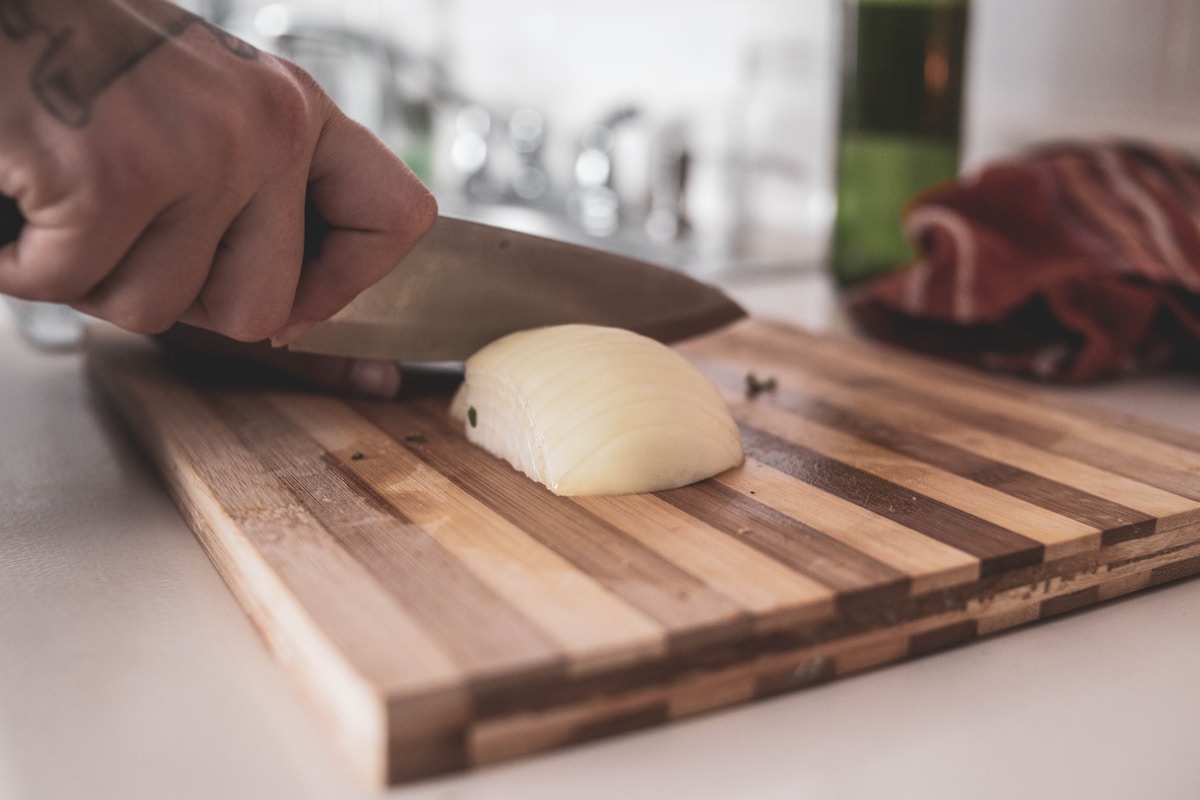
Does this sound familiar? You’ve found a wonderful recipe for a hearty vegetable soup. You’re excited. You’ve bought all the beautiful, fresh ingredients. You pull out your cutting board, and then you see it: the mountain of carrots, onions, and celery you need to chop. Suddenly, the fun drains away and it feels like a chore. The chopping takes forever, your hand gets tired, and when you’re done, you have a pile of pieces in every size imaginable.
If you’ve ever felt that way, I want you to know you are not alone. Every single person who cooks has been there. We see chefs on TV moving their knives like a blur and think it’s some kind of magic talent. But I’m here to tell you a secret: it’s not magic. It’s a technique, a physical skill, just like learning to ride a bike. And just like riding a bike, it feels wobbly and awkward at first, but with a little understanding and practice, it will become second nature.
Forget about speed for now. Today, we’re going to focus on two things: safety and confidence. Once you have those, the speed will come naturally. Let’s demystify the knife and turn that mountain of prep work into a calm, satisfying part of your cooking journey.
Your New Best Friend The 8-Inch Chef’s Knife
First, let’s talk about your most important tool. You might have a big wooden block on your counter filled with knives of all shapes and sizes: a long serrated one, a tiny one, a cleaver-looking one. While they all have their uses, 90% of your cutting can and should be done with one single knife: a good 8-inch chef’s knife.
Investing in one solid chef’s knife is far more valuable than owning a dozen mediocre ones. Why? Because a good knife feels like an extension of your hand. It’s balanced, it holds a sharp edge, and its shape is designed for versatility. You can use it to dice an onion, mince garlic, chop herbs, and even break down a chicken.
When you’re starting out, you don’t need to spend a fortune. There are fantastic entry-level options that professionals swear by. The Victorinox Fibrox Pro 8-Inch Chef’s Knife is a legendary workhorse, beloved for its sharp edge and comfortable grip, often priced under $50. If you want to invest a bit more, brands like Wüsthof or Zwilling J.A. Henckels offer incredible German-made knives that can last a lifetime. The key is to find one that feels good in your hand. It shouldn’t feel too heavy or too light. When you hold it, the weight should feel evenly distributed between the blade and the handle.
The Two Handshakes That Change Everything
How you hold the knife and the food is the absolute foundation of good technique. Getting this right will transform your control and, most importantly, keep your fingers safe. It will feel strange at first. (That’s a promise.) Your brain has a default way of holding things, and we’re going to retrain it. Stick with it.
1. The Pinch Grip (For Your Knife Hand)
Most beginners grab the knife handle like it’s a hammer, with all their fingers wrapped around it. This gives you power, but it sacrifices control. Instead, we’re going to use the “pinch grip.”
- Take your thumb and forefinger and literally pinch the blade itself, right where the handle meets the metal. Your thumb should be on one side, and your curled forefinger on the other.
- Then, wrap your remaining three fingers comfortably around the handle.
This grip connects your hand directly to the blade, giving you precise control over its every movement. It’s the difference between steering a car with one finger on the wheel versus having a firm, 10-and-2 grip.
2. The Claw Grip (For Your Guide Hand)
This is the big one. This is the grip that will prevent you from ever cutting a fingertip. Your other hand—the one holding the food—is your guide hand. Its job is to hold the food steady and act as a safe barrier for the knife.
- Instead of holding the vegetable with your fingertips pointing out, curl them inward, like you’re gently gripping a ball. Tuck your thumb behind your fingers.
- Your knuckles should be bent and pointing forward. Now, rest the flat side of the knife blade against your knuckles.
- As you slice, your knuckles guide the blade, ensuring it moves straight up and down. Your fingertips are safely tucked away, impossible for the blade to reach.
Think of your knuckles as a safety bumper. The knife slides along them, but it can’t jump over them to get to your fingers. It will feel slow and clumsy. You’ll want to flatten your fingers out. Don’t. Practice the claw, even if you’re just slicing a single carrot. (Your future self will thank you.)
Learning the Rhythm The Rock-Chop Motion
Now that your hands are in position, let’s talk about the movement. Forget frantic, up-and-down chopping. The most efficient and least tiring way to use a chef’s knife is the “rock-chop.”
The curved belly of a chef’s knife is designed for this motion. Here’s how it works:
- Place the tip of the knife on the cutting board.
- Keep the tip down on the board as your anchor point.
- Raise and lower the heel (the back part) of the knife in a rocking motion, pushing the knife forward slightly with each downward chop.
- As you chop, slowly slide your guiding “claw” hand backward along the vegetable to make the next cut.
This motion uses the full length of the blade and is powered by your whole arm, not just your wrist. It’s smooth, rhythmic, and once you get the hang of it, surprisingly fast. A great way to practice is with a stalk of celery. It’s long, straight, and inexpensive, so you can make dozens of cuts to find your rhythm.
Why Uniform Cuts Are a Cook’s Superpower
Have you ever roasted a tray of vegetables, only to find that some tiny pieces are burnt to a crisp while the big chunks are still raw in the middle? This is the direct result of inconsistent knife cuts.
Cutting your ingredients to a uniform size is one of the single most important things you can do to improve your cooking. It’s not about making your food look pretty for a photo (though it does help!). It’s about making it cook evenly.
- Even Cooking: When every piece of potato in your roast or onion in your sauté is the same size, they all cook at the same rate. No more burnt bits and raw centers.
- Better Flavor: In a soup or stew, uniformly sized vegetables release their flavors into the broth at a consistent pace, creating a more balanced and harmonious dish.
Start by thinking in general terms. For a rustic stew, a large dice (about 3/4-inch) is perfect. For a quick sauté or a soup base (a mirepoix), a medium or small dice (1/2-inch to 1/4-inch) works best. The goal isn’t perfection, but consistency. Try to make every piece about the same size. This simple act of mindfulness during your prep will pay huge dividends in the final dish.
Kitchen Hack The Surprising Truth About Sharp Knives
Here is the most important safety rule in the kitchen, and it’s one that feels completely wrong at first: A sharp knife is a safe knife. A dull knife is dangerous.
It seems counterintuitive, right? But think about it. When you use a dull knife on something with a tough skin, like an onion or a butternut squash, what do you have to do? You have to push. Hard. All that force makes the knife more likely to slip off the rounded surface and go somewhere you don’t want it to—like your hand.
A sharp knife, on the other hand, bites into the food with very little pressure. It does the work for you. It goes exactly where you guide it, making it predictable and much, much safer.
You don’t need to become an expert at using sharpening stones. A simple pull-through sharpener used every few months and a honing steel used before each cooking session will keep your blade in excellent shape. Honing doesn’t sharpen the blade, but it realigns the microscopic edge, making it cut more effectively.
Try This Tonight Mirepoix Magic
Ready to put this all together? Let’s try a simple, low-pressure exercise. We’re going to make a mirepoix, the classic aromatic vegetable base for thousands of soups, stews, and sauces. It’s just onion, carrot, and celery.
- Get Your Tools: Grab your 8-inch chef’s knife and a cutting board. Place a damp paper towel under your board to keep it from slipping.
- The Veggies: You’ll need 1 large onion, 2 carrots, and 2 celery stalks.
- Practice Your Grips: Take your time. Hold the knife with the pinch grip. Hold the onion with the claw grip.
- Chop Away: Focus on making all your pieces a consistent, medium dice (about 1/2-inch). Use the rock-chop motion. Don’t rush. Feel the rhythm. Notice how the knife glides against your knuckles.
When you’re done, you can sauté your mirepoix in a little butter or olive oil over medium heat until softened (about 8-10 minutes) and use it as a base for a soup, or you can pop it in a freezer bag and save it for another day. You just did real, foundational prep work.
Remember, this is a skill. It takes practice. Be patient with yourself. The first few times, you will feel slow. That’s not just okay; it’s required. Focus on the feeling of the grips and the motion. Before you know it, you’ll be looking at that pile of vegetables not with dread, but with the quiet confidence of someone who knows exactly what to do.