Let’s be honest. For a long time, the sharpest thing in my kitchen was my wit. My big chef’s knife felt more like a medieval weapon than a cooking tool, and my chopped vegetables looked like a collection of distant, non-related cousins. If you’ve ever chased a rogue piece of onion across your cutting board, you’re in the right place.
Learning to use a knife confidently isn’t about becoming a super-fast TV chef who can chop blindfolded. (Please, never do that.) It’s about safety, control, and making your ingredients cook evenly. Once you understand a few simple principles, that intimidating blade will start to feel like an extension of your own hand. And trust me, it’s a game-changer.
Your Handshake With The Knife
Before you even touch a vegetable, let’s talk about how you hold the tools. Getting this right is 90% of the battle, and it all comes down to two things: how you hold the knife and how you protect your other hand.
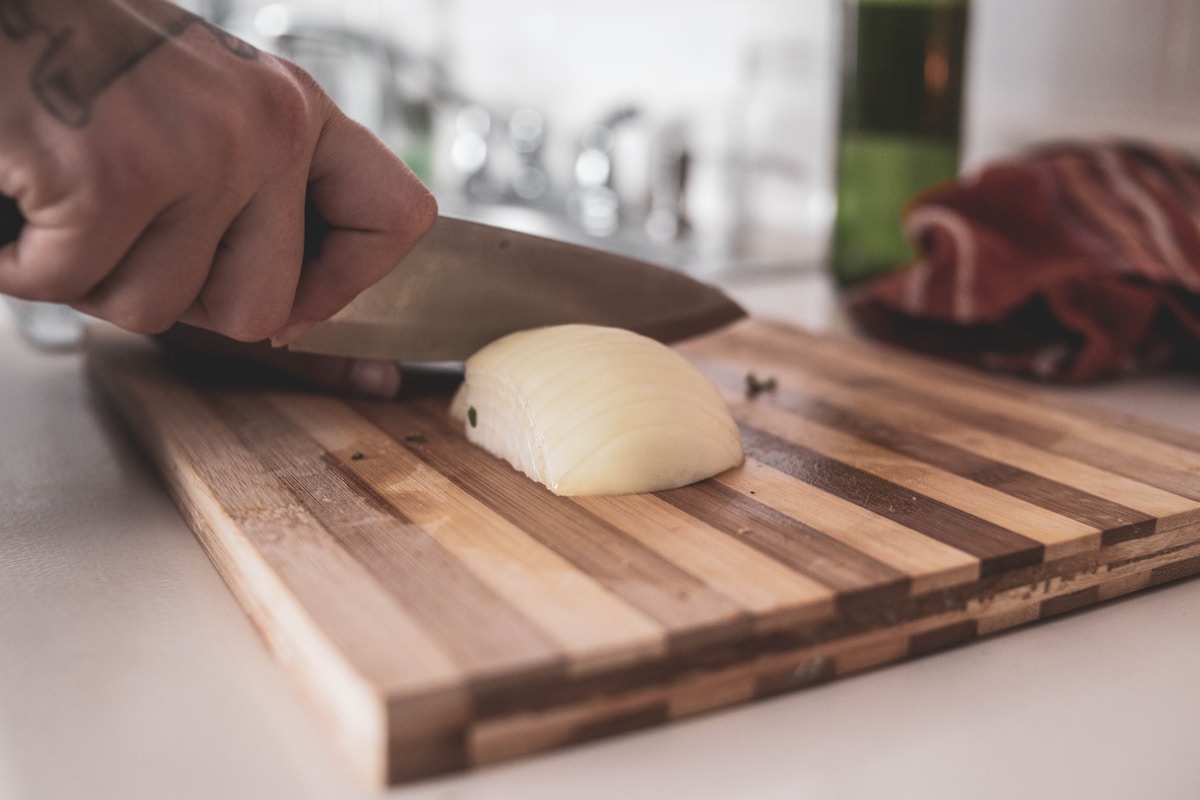
Holding the Knife: Most beginners grab the knife handle like it’s a hammer. This gives you very little control. Instead, try the “pinch grip.” With your thumb and forefinger, pinch the blade itself, right where it meets the handle. Then, wrap your other three fingers around the handle. It might feel weird at first, but you’ll immediately notice how much more control you have over the tip and the angle of the blade.
Protecting Your Guide Hand: This is the most important secret of all. Your non-knife hand isn’t just there to hold the food; it’s your guide and your safety bumper. Curl your fingertips under your knuckles, like you’re making a gentle claw. Your knuckles should stick out, acting as a flat, safe wall for the side of the knife blade to rest against. The blade goes up and down, and your knuckles guide it. Your precious fingertips? They are tucked safely out of the way. This is the famous “claw grip,” and it’s your best friend in the kitchen.
The Onion An Unlikely Teacher
There’s a reason chefs-in-training practice on countless bags of onions. They have layers, a tricky root, and they make you cry. If you can conquer an onion, you can conquer anything. Here’s the no-fuss, professional way to do it.
- Cut it in Half: Place the onion on your board and slice it in half from the stem to the root. The hairy root end is like glue—it holds all the layers together. Don’t cut it off yet!
- Peel It: Lay one half flat-side down. Now it’s stable and won’t roll away. Trim the top stem end, and the papery skin should peel off easily.
- Vertical Slices: With the flat side still down, make thin, vertical slices into the onion, starting from one side and moving to the other. Stop your cuts just before you get to the root end. (Remember, the root is holding it all together for you.)
- Horizontal Slices: Turn the onion so the root is facing away from you. Carefully make one or two horizontal cuts through the middle of the onion, again stopping before you reach the root.
- Dice! Now, simply slice down across your previous cuts. Perfect, uniform little dice will fall away from your knife. No more chasing bits and pieces! When you get to the root, you can discard that last little bit.
Have you ever roasted carrots and found that some were mushy while others were still crunchy? That’s almost always because of uneven knife cuts. When your pieces are all different sizes, they cook at different rates.
Getting a handle on a few basic cuts ensures everything in your pan cooks perfectly together. The building blocks are simple:
- Julienne: This just means cutting a vegetable into thin little matchsticks. It’s great for salads, stir-fries, and slaws.
- Batonnet: Think of these as slightly thicker julienne sticks, like a classic French fry shape. They are the starting point for a dice.
- Dice: A dice is just a cube. To get a perfect dice, you first cut your vegetable (like a potato or carrot) into flat planks, then cut the planks into batonnet (sticks), and finally, line up the sticks and cut them into perfect little cubes.
Don’t stress about perfection. The goal is consistency. If all your pieces are about the same size, you’re going to get a much better result.
Kitchen Hack A Damp Paper Towel
Here’s a tiny tip that makes a huge difference. Does your cutting board slide around on the counter while you’re trying to chop? This is super common and a little bit dangerous. To fix it, simply wet a paper towel, wring it out so it’s damp (not dripping), and lay it flat on your counter. Place your cutting board on top. It will stick like magic, giving you a stable, safe surface to work on. (Your future self will thank you.)
Try This Tonight Your First Assignment
Enough reading—it’s time to (safely) do. Tonight, I want you to grab one potato or one onion. That’s it. Put on some music, take a deep breath, and put your cutting board on a damp paper towel.
Your mission, should you choose to accept it, is to practice your dicing. Use the pinch grip. Use the claw grip. Focus on making all the little pieces look related. They don’t have to be perfect twins, but they should at least look like close cousins. Go slow. This is about building muscle memory, not winning a race. The more you do it, the more natural it will feel. Soon, you won’t even have to think about it, and you’ll wonder why you were ever afraid of that knife in the first place.


 Lucas
Lucas